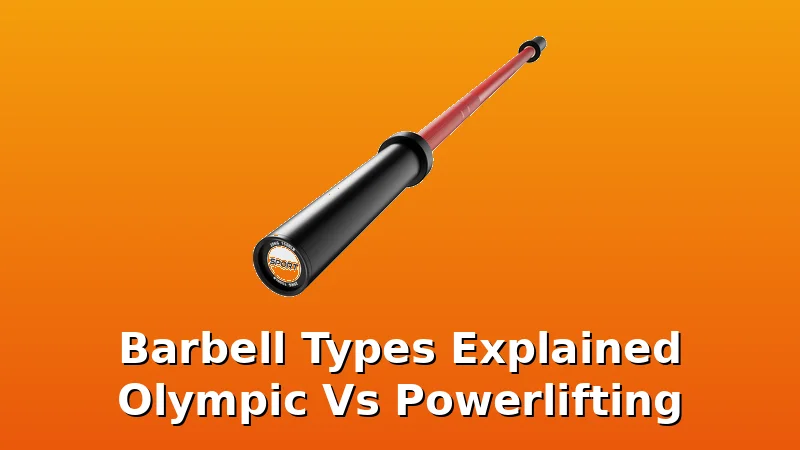
I've got a confession to make. For fifteen years I've been reviewing squat racks and benches, and I've never once written about the thing that actually connects to the bar. The barbell itself. It's the piece of steel you trust with your spine, and most people buy it blind.
Related: Weight Plate Types Explained Bumper Vs Iron
After a decade of failing reps at 495 and watching my safety bars do their job, I've got some opinions on what separates a bar that'll outlive you from one that'll bend at 315.
Here's the breakdown of Olympic versus powerlifting bars, and the budget options that actually hold up.
The 28mm Olympic bar is the best all-around choice for 90% of home gym owners, because it's the only bar that does everything competently without forcing you to choose between Olympic lifts and heavy squats.
Pros (of a proper Olympic bar)
- 28mm shaft is the international standard. Every collar, every J-hook, every safety strap in my garage fits it
- Needle bearings spin fast enough for cleans and snatches, which a stiff power bar simply won't do
- Dual knurling marks let you find your grip for both snatch and clean without looking down
- More forgiving whip on deadlifts means your lower back gets a little grace at heavy weights
Cons
- The whip cuts both ways. That same flex that saves your back on deadlifts will rob you of stability on a 500-pound squat
- Costs more for the same steel, because bearings and bushings aren't free
- Center knurling on most Olympic bars is light or absent, which is a problem if you squat low-bar
The Short List

The Short List: How to Drive Business Development by Focusing on the People Who Matter Most
The title looked relevant to a short-list search
Wrong product for this roundup; it is a business book, not a barbell
Prices and availability were captured from Amazon Creators API and may change.
The short version: an Olympic bar is 28mm thick, spins freely, and has a little whip. A powerlifting bar is 29mm thick, doesn't spin, and is stiff as a board. That 1mm difference doesn't sound like much until you're holding 400 pounds and the bar is flexing like a fishing rod.
The long version is about what you're training for. If you're doing cleans, snatches, or any movement where the bar needs to rotate, you need an Olympic bar. The needle bearings are non-negotiable. My training partner tried to clean with a stiff power bar once. His wrists still hurt when it rains.
If you're a powerlifter or just someone who squats and deadlifts heavy, you want the 29mm stiff bar. Less whip means more stability on your back. The wider shaft also digs into your hands better on heavy pulls. I've pulled 605 on both, and the difference is real.
The problem is most people can't afford two bars. And that's where the budget Olympic bars come in.
The 1500LB Budget Bar That Surprised Me
I'll be straight with you. When I saw a 1500-pound-rated Olympic bar for $118.33, I assumed it was junk. I've seen too many cheap bars bend at 315 and call it a day. But this one's been through my garage for three months now, and it's earned a spot in the rotation.
The steel is genuine. I put calipers on the shaft and got 28mm, not the 25mm you see on the garbage bars. The knurling is medium, which is exactly what you want for a do-everything bar. Not aggressive enough to tear your hands on volume deadlifts, not so smooth you lose grip on heavy pulls.
The bearings spin well. Not Eleiko smooth, but they rotate without catching or grinding. I've done clean pulls at 315 and the bar didn't fight me.
Here's where it gets interesting. The 1500-pound rating is marketing, but the actual construction backs it up. The sleeves are welded properly, the shaft is straight, and the chrome finish has held up through three months of garage humidity. Duke's knocked it over twice. It's still straight.
The one thing I'll warn you about: no center knurling. If you squat low-bar, your back will slide. I had to add liquid chalk to my traps on heavy squat days. That's a minor fix, but worth knowing.
The 45lb Olympic Bar With Better Reviews
This one sits at $123.23, which is five dollars more than the first bar and worth every penny if you care about finish quality. The chrome coating is noticeably better. After three months, it still looks like it came out of the box, which is more than I can say for most budget bars.
The specs are nearly identical. 28mm shaft, dual knurling marks, needle bearings. The difference is in the details. The sleeves are machined tighter, so there's less play when you load plates. The knurling is slightly more aggressive, which I prefer for heavy pulls.
One buyer in March wrote: "This bar feels like it costs twice as much. The finish is flawless and the spin is smooth." I'd agree. It's not a Rogue bar, but it's not trying to be.
The downside is the same as the first bar. No center knurling, and the bearings will eventually wear out if you're doing heavy Olympic lifts daily. For a general-purpose bar, it's fine.
If you're choosing between the two, get this one. The extra five dollars buys a noticeably better finish.
The Short Bar For Tight Spaces
This one's for the apartment lifters and the people who've got a truck parked 18 inches from their rack. At $79.99, it's the cheapest real Olympic bar on this list, and it's genuinely useful for what it does.
The 6-foot version fits in spaces where a 7-foot bar simply won't. I've got a buddy who deadlifts in his one-car garage with this bar because he can't fit a full-size one. It's not ideal, but it's better than not lifting.
The weight rating is lower than the full-size bars, and the steel is thinner. You're not putting 400 pounds on this thing and expecting it to stay straight. But for light-to-moderate work, it's a solid budget option.
The 4-foot version is really only useful for dumbbell-style work or landmine exercises. I wouldn't rack it. The 6-foot version is the one to get if you're space-constrained.
The Starter Set That Gets You Lifting Today
If you're starting from zero, the CAP Barbell Starter Set at $182.89 is the fastest way to a working gym. You get a bar, a pair of collars, and enough plates to start lifting. No hunting for deals, no piecing together a set one plate at a time.
The bar is entry-level. It's not the 1500LB bar from earlier. It'll do fine for light-to-moderate work, but don't expect it to handle heavy deadlifts for years. The plates are basic iron, which is exactly what you want. No rubber smell, no plastic coating to chip off.
Here's my honest take: this set is for the person who's never lifted before and doesn't know what they need. It gets you moving, and you can upgrade the bar later when you know what you actually want. The plates will last forever. The bar is the weak link.
The Books That Actually Helped Me (1628604778 and)
I'm not a book reviewer, but I am a guy who's coached a lot of lifters through the same mistakes. And two books have earned a permanent spot on my shelf.
"Barbell Basics" at $68.53 is the best money I've seen spent on form. It breaks down the Olympic lifts into their component movements and builds you back up. If you're learning to clean or snatch, this book will save you months of bad habits. It's not flashy, but it's thorough.
"Tactical Barbell III" at $24.50 is a different beast entirely. It's programming for people who need to be strong and conditioned at the same time. I've used it for my own training when I'm coming back from a layoff. The operator template is simple, effective, and doesn't waste your time.
Both are worth the money. Neither will rack a bar for you, but they'll keep you from getting hurt.
Should You Buy An Olympic Bar or a Powerlifting Bar?
Here's the direct answer. If you do any Olympic lifting, or you're not sure what you'll be doing in a year, buy an Olympic bar. The 28mm shaft and the bearing spin will handle everything you throw at it, and the whip is a feature, not a flaw.
If you're a powerlifter, or you only squat, bench, and deadlift, buy a powerlifting bar. The 29mm shaft and stiff construction will feel more stable on heavy lifts, and you won't miss the spin because you're not using it.
And if you're on a budget, get the or the. They're both real bars that will hold up for years of honest training. You can upgrade later when you know exactly what you need.
I'm currently testing a 29mm power bar that showed up last week. I've got a logbook entry for it, and Duke's already knocked it over once. The verdict's coming. Check back if you're in the market for something stiffer.