Most home gyms do not fail because somebody picked the wrong brand. They fail because the first two purchases fight each other. A home gym rack and dumbbells setup is a budget decision as much as a strength decision: the rack claims floor space and ceiling height, the dumbbells claim money, and whichever one you buy first shapes everything that comes after it. Get the order wrong and you end up with a pair of adjustable dumbbells and nowhere safe to put a loaded bar, or a rack you cannot press inside because the joists are closer than you thought.
This is not a ranking. It is an explainer on what actually separates a rack you keep for a decade from one you resell in eighteen months, plus how four current options fit four different garages. Everything below is about matching equipment to the room you actually have, not the room you plan to build someday.
Related: How to Anchor a Power Rack in a Garage Gym →
Quick answer
Buy the rack first if you train barbells. A rack with real safety bars is the one piece of home gym equipment that has to outlive every other piece you own, because it is the piece that catches a missed rep. Buy dumbbells first if you rent, if your ceiling is low, or if your training is built around pressing, rows, and carries instead of squats. The HULKFIT Power Rack covers barbell work and lat work in a single footprint. The NÜOBELL pair covers the widest adjustable range with a twist mechanism. The 4-in-1 soft shell set covers the smallest budget. The CAP hex set covers the lifter who wants fixed weights and storage in one purchase.
Four useful options
| Model | Best fit | What stands out |
|---|---|---|
| HULKFIT Power Rack, Squat Rack with LAT Pulldown for Home Gym Training | Barbell lifters who want squats and lat work in one frame | A power rack and squat rack frame with an integrated lat pulldown |
| Adjustable Dumbbell Set, 4-in-1 Soft Shell Weights 35/62lbs | First garage or apartment setup on a tight budget | Soft shell plates in a 4-in-1 configuration |
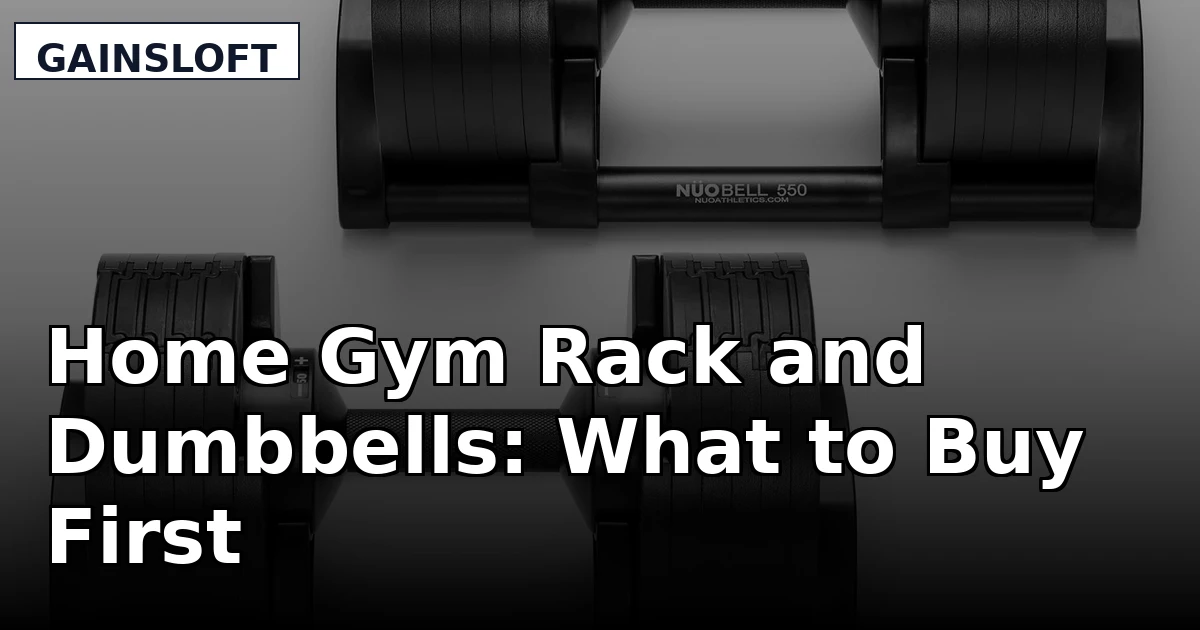
| NÜOBELL® Adjustable Dumbbell Set, 5-50 LB or 5-80 LB, Easy Twist 2024-25 Model, All-In-One Weights Set (Pair) for Home, Original Manufacturer | Lifters who want one pair to cover warm-ups through heavy pressing | Twist adjustment, sold as a pair, offered in 5-50 LB and 5-80 LB builds |
| CAP 550lb Hex Dumbbell Set with 2-Tier Storage Rack, Chrome Grip | Lifters who want fixed dumbbells plus a place to put them | Hex heads, chrome grip, two-tier storage rack included |
The anchor: HULKFIT Power Rack, Squat Rack with LAT Pulldown for Home Gym Training
This is a rack first and a lat station second, which is the correct order. It gives you uprights, a base, and a pulldown attachment on one footprint, so a garage that can only fit one large steel structure still gets barbell work and pulling work. Before you buy any rack, read the capacity sticker and then go looking for the tube gauge. A rating printed on a sticker is a marketing claim until you confirm the steel behind it, and thin tube flexes under loads it was never meant to see. Check the hardware too: grade-8 bolts and a base you can either bolt to concrete or trust as a flat-foot design matter more than powder coat. If you plan to use the pulldown, measure the travel above the top of the frame, because a lat attachment needs headroom the rack itself does not.
The budget adjustable: Adjustable Dumbbell Set, 4-in-1 Soft Shell Weights 35/62lbs
Soft shell plates exist for a reason: they are quieter on the floor and kinder to a rental unit where you cannot bolt anything down and cannot risk a chip in the concrete. The trade is that you are not buying a set that will still feel heavy to a strong lifter in three years. If your working weights are moderate and your main constraint is money and space, this is the category that gets you training this month instead of next spring. Be honest about the ceiling on the load, because a set that tops out below your pressing weight becomes a warm-up set the day you outgrow it.
The adjustable pair: NÜOBELL® Adjustable Dumbbell Set, 5-50 LB or 5-80 LB, Easy Twist 2024-25 Model, All-In-One Weights Set (Pair) for Home, Original Manufacturer
Twist mechanisms are the reason adjustable dumbbells finally work for people who actually train rather than people who just want a set in the corner. Changing weight between sets stops being a chore, which means you stop skipping the drop sets and back-off work that make a home setup worth owning. The two build options matter more than they look: the 5-50 LB range covers most pressing and rowing for a lifter working in the low hundreds, and the 5-80 LB build is the one you want if your dumbbell bench is already past the middle of the lighter range. Whatever you choose, treat the mechanism with some respect. Twist systems do not want to be dropped from overhead onto concrete, and a set of mats under your working area is cheaper than a replacement pair.
The fixed set with storage: CAP 550lb Hex Dumbbell Set with 2-Tier Storage Rack, Chrome Grip
Fixed dumbbells solve a problem adjustable sets never fully solve: nobody has to change anything, so the set is always ready. Hex heads stay put when you set them down between sets, which matters more than it sounds like it does in a garage with a sloped floor. The storage rack is the quiet part of the value here, because loose dumbbells on the floor turn a training space into an obstacle course, and an organized rack keeps the walkway to your bar clear. The trade is space and cost per pound. A fixed set takes up a footprint that adjustable dumbbells do not, and once you own it, the weights are what they are.
Prices and availability may change. Product images, names, and retailer links must be matched by verified ASIN. Do not state a current price, rating, stock status, or measured result without current evidence.
Steel gauge, welds, and what a rack is actually rated for
You are not buying steel. You are buying the welds that hold the steel together, and the gauge of the tube those welds sit on. The industry standard for a serious rack is 11-gauge steel, roughly 0.12 inches of wall thickness. Thinner tube flexes, and flex is the thing that turns a heavy squat into an event. When you look at a rack, check where the welds land: the corner joints on the uprights, the base plates, and the attachment points for j-hooks and safety bars. A weld that sits on top of the metal without fusing into it is cosmetic. A weld with real penetration is structural, and you can usually see the difference at the toe of the bead.
Then look at the rating. A capacity number is only meaningful next to the gauge and the hardware. A rack that ships with hardware store bolts and a four-figure sticker is telling you two different stories. J-hooks are the other weak point. Cheap hooks bend and tip when you re-rack a bar crooked, and a hook that tips at the wrong moment is how a rep ends up on the floor instead of back on the uprights. Safety bars and spotter arms are the last line. If the safety equipment is rated below the weight you actually squat, it is decoration, not protection.
Adjustable versus fixed dumbbells, and when each one wins
Adjustable dumbbells win on space and cost per pound. One pair replaces a whole rack of fixed weights, and a twist or 4-in-1 system lets you move from warm-up to working weight without walking across the room. What you give up is speed, and in some designs, durability. A mechanism with moving parts is a mechanism you can break, and soft shell plates are built for floors that cannot take a dropped hex head.
Fixed dumbbells win on readiness and abuse tolerance. They are always loaded, they survive being set down hard, and a hex head does not roll under your foot mid-set. What you give up is floor space and money, because you pay for every pound in the set whether you use it or not.
Neither category is wrong. The mistake is buying adjustable dumbbells for a training style that drops weights, or buying a fixed set for a room with three feet of walkway.
- Measure the room before you buy anything: ceiling height under the lowest joist, wall to wall, and the clearance in front of where the rack will sit.
- Decide whether you can drill. Concrete anchors change what a rack can be, and a rental unit usually rules that out.
- Count the lifts you actually do, not the lifts you plan to do. Barbell work points to a rack. Dumbbell work points to dumbbells.
- Add up the full purchase, not the headline item. A rack needs a bar, plates, and a bench to be useful.
- Buy the safety-critical piece first. Whatever catches a failed rep should be in the garage before the accessories.
Matching the purchase to your room
- Check the slope of the floor with a level before you assemble anything, because a rack on an uneven slab rocks no matter how tight the bolts are.
- Bolt to concrete where you can, and use the specified anchors rather than whatever is in the junk drawer.
- Keep a bar's length plus plate room in front of the rack so you are never pulling out of a wall.
- Put dumbbells on a rack or a stand instead of the floor, so the walkway stays clear at the end of a set.
- Leave headroom above the rack if you are running a lat pulldown, because the attachment needs travel the frame does not.
- Plan the flooring at the same time as the rack. Mats are cheap, and a cracked slab is not.
Which option should you choose?
Choose the HULKFIT Power Rack, Squat Rack with LAT Pulldown for Home Gym Training when you train barbells and want squats, pressing, and lat work in one structure. Choose the Adjustable Dumbbell Set, 4-in-1 Soft Shell Weights 35/62lbs when your budget and your floor space are both tight and your working weights are moderate. Choose the NÜOBELL® Adjustable Dumbbell Set, 5-50 LB or 5-80 LB, Easy Twist 2024-25 Model, All-In-One Weights Set (Pair) for Home, Original Manufacturer when you want one pair that adjusts fast enough to keep up with a real session, and you have a floor that can take it. Choose the CAP 550lb Hex Dumbbell Set with 2-Tier Storage Rack, Chrome Grip when you want fixed weights that are always loaded and storage included in the same purchase.
Two caveats. First, capacity ratings are claims until you match them against tube gauge and hardware, so verify before you load anything heavy. Second, adjustable dumbbells and dropped weights do not mix, and no mechanism survives being thrown.
The bottom line
The rack is the piece that has to outlive everything else, because it is the piece that catches a missed rep. If you train barbells, that purchase comes first, and it should be judged on steel gauge, weld quality, hardware grade, and the rating of the safety bars rather than the color of the frame. If your training is dumbbell-based, or your garage cannot be drilled and your ceiling is low, the dumbbells come first and the rack waits until you have a room that supports it. Either way, measure the space, decide whether you can anchor anything, and buy the safety-critical piece before the accessories. The set you keep is the one that matched the room you actually have.