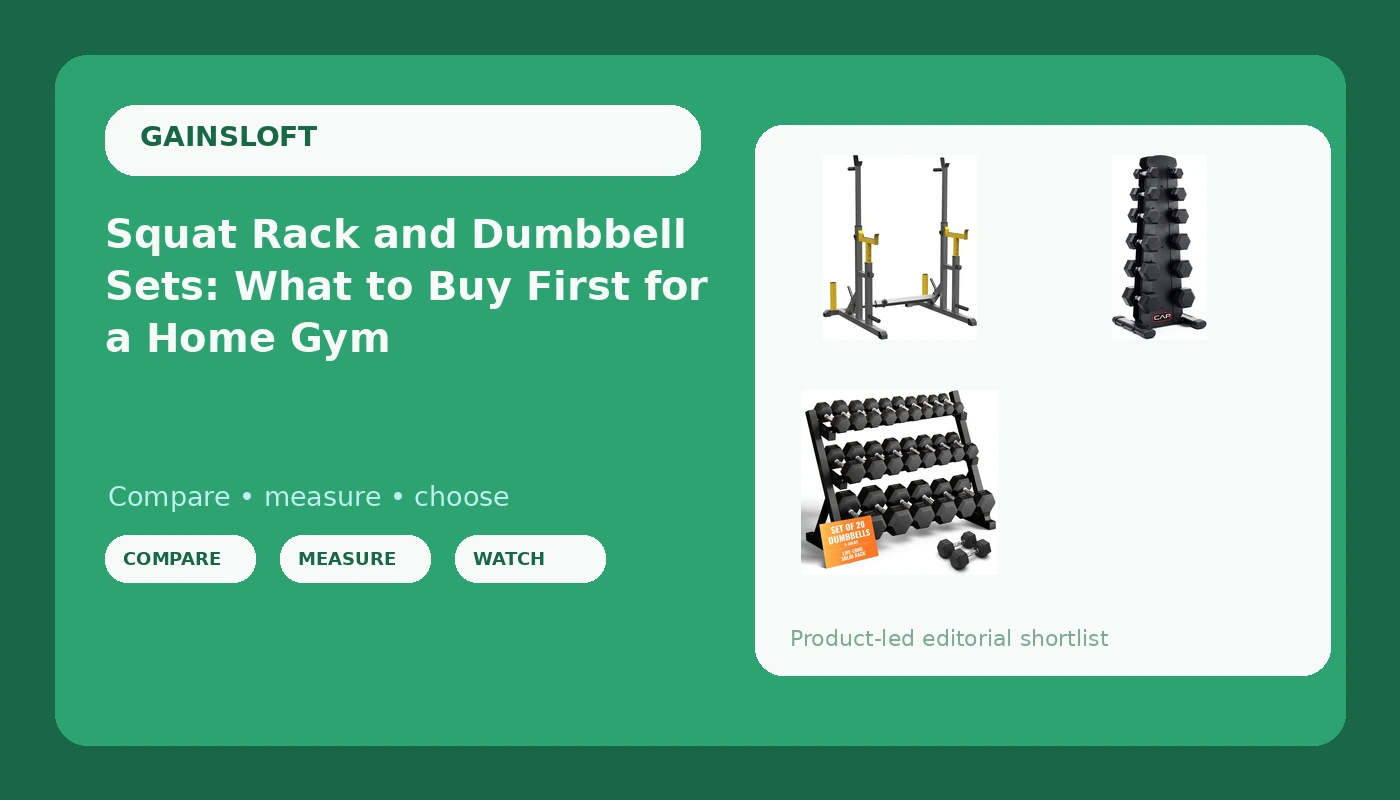
A home gym usually gets built in the wrong order. People buy the fun stuff first, a barbell here, a few plates there, and then discover that the two purchases that actually shape the room, the squat rack and dumbbell set, are the ones they still cannot afford. The order matters, because a rack decides where you lift, how you bail out of a failed rep, and how much floor you give up, while dumbbells decide what you can train when the bar is loaded or when you simply do not feel like loading it. What follows is not a ranking. It is an explanation of what each of these three options is for, what the numbers on the label mean, and how to work out which one belongs in your garage first.
Related: How to Anchor a Squat Rack to a Concrete Garage Floor →
Quick answer
If you train alone with a barbell, buy the rack before the dumbbells, because safety bars are what let you take a heavy squat to failure without a spotter. If your training is mostly dumbbell work, or you already own a rack and a bar, then a dumbbell set with its own storage rack solves the loading and storage problem in one purchase. The three options below cover a budget adjustable rack, a rubber coated set that starts small, and a large hex set that arrives as a complete rack and dumbbell package. Every capacity figure quoted here comes from the manufacturer's own listing, not from independent load testing.
Three useful options
| Model | Best fit | What stands out |
|---|---|---|
| K KiNGKANG Adjustable Squat Rack,Bench Press for Home Gym Load 690LBS | A first rack in a garage or spare room | Adjustable frame that covers squat and bench positions, with a manufacturer-stated 690 lb load rating |
| CAP Rubber Coated Dumbbell Weight Set with Vertical Rack | 100 lb, 150 lb, and 210 lb Options | Starting dumbbell work in a tight space | Vertical rack storage and three set sizes: 100 lb, 150 lb, and 210 lb |
| Rubber Hex Dumbbell Set with Rack, 8/10/12/15/20 Pair (450/550/780/1200/1550/2100 lbs total) Weight Rack with Dumbbells for Home Gym & Strength Training | Filling a gym with a full dumbbell range | Rubber hex heads listed in 8, 10, 12, 15, and 20 lb pairs, with total package weights from 450 lb to 2,100 lb depending on the option |
The rack: K KiNGKANG Adjustable Squat Rack,Bench Press for Home Gym Load 690LBS
Here is where you have to read past the sticker. A load rating on a rack like this is a static capacity claim, which means the frame is stated to hold that much weight sitting in the hooks, not to survive a dropped barbell landing on the safety arms from the top of a squat. Those are different events, and the second one is the one that hurts you. Before you buy any budget rack, look at three things the listing usually tells you if you dig: the tube gauge of the uprights, the thickness of the J-hooks and safety arms, and the grade of the hardware that holds the joints together. An adjustable rack at this end of the market typically trades some steel thickness for the adjustability and the price, and that trade is fine for a lifter whose working weights sit well under the rated number. It is a poor trade for someone squatting close to it every week. The adjustability is also the feature that matters most if you bench in the same frame, since you need the hooks at two very different heights. What you give up compared with a heavier flat-foot rack is the margin at the top of the rating, and that margin is exactly what you are paying for when you step up in price.
The starter set: CAP Rubber Coated Dumbbell Weight Set with Vertical Rack
Rubber coating is not cosmetic. It keeps the heads from chipping your concrete, it cuts the clang when you set a dumbbell down between sets, and it stops the rust that bare cast iron develops in a humid garage. The trade-off with a vertical rack is geometry: you are stacking a lot of weight in a tall, narrow column, so where you put it matters more than how much it holds. Against a wall or tucked into a corner, it is out of your walking path. Standing free in the middle of the floor, it is a thing you can catch with a hip on the way to the rack. The other thing to think about is increments. Fixed dumbbells step in whatever sizes the set ships with, so if your dumbbell press jumps from a comfortable weight to a weight you cannot move, there is no 2.5 lb plate to save you. That is why the set size matters more than the total weight. A 210 lb set with sensible increments will carry a lifter much further than a 210 lb set that is mostly one heavy pair. Match the option to the weights you actually press, row, and curl, not to the biggest number on the page.
The full set: Rubber Hex Dumbbell Set with Rack, 8/10/12/15/20 Pair (450/550/780/1200/1550/2100 lbs total) Weight Rack with Dumbbells for Home Gym & Strength Training
Hex heads are the right shape for a home gym for one reason: they do not roll. A round dumbbell on a slightly sloped garage slab will find its way to the wall, and a hex head will sit where you left it. The important detail in this listing is the spread between the smallest and largest option. The 450 lb configuration and the 2,100 lb configuration are not the same product at different sizes, they are two different jobs. The small end suits someone building a dumbbell-only training setup or adding accessory work to a barbell program. The large end suits someone replacing a commercial gym membership outright, where the rack has to hold enough pairs that two people could work out at once. Buy the option whose heaviest pairs sit above your working weights with room to spare, because a dumbbell set is a closed inventory. You cannot add a pair later the way you can add plates to a bar. The rack included here also does something a vertical stand does not: it keeps the dumbbells at waist height in a row, which is faster to work from and easier to load than a column you have to reach into.
Prices and availability may change. Product images, names, and retailer links must be matched by verified ASIN. Do not state a current price, rating, stock status, or measured result without current evidence.
What a load rating on a budget rack actually tells you
A rack's capacity number is a claim about static load, and static load is the easy case. Steel sitting still in J-hooks is a very different problem from steel absorbing a 300 lb barbell dropped from chest height onto safety arms, which is what happens the first time you miss a rep. When you read a listing, separate the frame rating from the safety rating. Many racks quote one number for the whole structure and never tell you what the spotter arms are rated to catch, and the arms are the part standing between you and a barbell on your neck. Then look at the construction. Tube gauge is the honest measure of how much steel is in the uprights, and thinner tube flexes before it fails, which you feel as wobble long before anything breaks. Welds matter more than powder coat, and hardware matters more than either, because a rack that ships with soft bolts will loosen at the joints no matter how good the steel is. Bolt-together construction is not a flaw. A well-designed bolted rack with grade-8 hardware and tight joints is stable, and it is the only kind you can move in a hatchback. What you are checking for is not the assembly method, it is whether the pieces stay put under load.
Why a rack and a dumbbell set solve different problems
These two purchases are not competitors, they are answers to different questions. A rack exists to make heavy barbell training safe when you are alone, and to allow small jumps in load, since a pair of 2.5 lb plates is a real increment. A dumbbell set exists to train one side at a time, to give you a way to work when the bar is loaded or when your lower back has had enough, and to make a press or a row accessible in ten seconds. The costs are different too. A rack consumes vertical space: you need clearance above your head for pressing and for any pull-up bar the frame carries. A dumbbell set consumes floor space, and a full range with a rack consumes a lot of it. The failure modes are different as well. A rack fails by moving when it should not, which is why anchors and base width matter. A dumbbell rack fails by tipping, which is why tall, narrow storage wants a wall behind it. If you have to choose one to buy first, choose based on which kind of training you will actually do three nights a week, not on which one looks better in a photo of somebody else's garage.
- Measure the room before you shop: ceiling height for pressing and pull-ups, and floor footprint for whatever storage the set includes.
- Write down your real working weights for squat, bench, press, and row, then compare them against the stated rack rating and the heaviest pair in any dumbbell set.
- Decide whether you train alone. If you do, safety arms move to the top of the priority list, above adjustability and above finish.
- Check the hardware, tube gauge, and safety arm rating on a rack listing before you look at the color, because the color is the only part that cannot hurt you.
- Match the dumbbell total to your training rather than to the discount. A set whose heaviest pair is under your pressing weight has a short useful life.
Setting up a garage gym without wasting money
- Put the rack on a level surface. A frame that rocks on an uneven slab is unstable before a single plate goes on it, and no rating sticker fixes that.
- If the rack can be bolted and you own the floor, bolt it. If you rent, use the flat feet and check the base width against how wide your stance gets.
- Set the safety arms at a height where you can just barely fail a squat underneath them, then confirm the height with an empty bar before you load anything.
- Keep a vertical dumbbell rack against a wall or in a corner so it cannot be clipped on the way past, since tall narrow storage is the tipping risk.
- Put rubber flooring under the rack and the dumbbell area. It protects the slab, deadens the noise, and gives rubber coated heads less reason to slide.
- Budget for the bar and the plates separately from the rack. A rack with no bar is a very sturdy clothes horse.
Which option should you choose?
Choose the K KiNGKANG Adjustable Squat Rack,Bench Press for Home Gym Load 690LBS when you need a first rack that handles both squatting and benching, you train alone, and your working weights sit comfortably under the stated 690 lb rating. Choose the CAP Rubber Coated Dumbbell Weight Set with Vertical Rack | 100 lb, 150 lb, and 210 lb Options when your training is dumbbell-based, your space is tight, and one of those three set sizes matches the weights you actually use. Choose the Rubber Hex Dumbbell Set with Rack, 8/10/12/15/20 Pair (450/550/780/1200/1550/2100 lbs total) Weight Rack with Dumbbells for Home Gym & Strength Training when you want a complete dumbbell range with storage in a single purchase and you have the floor space and the budget for a large set.
None of the capacity figures above come from independent testing. They are the manufacturers' own claims, and the practical details that decide whether a rack or a dumbbell set works in your garage, tube gauge, hardware grade, safety arm rating, and the increments inside a set, are things you should confirm in the listing before you buy.
The bottom line
If you train alone under a barbell, buy the rack first, because the safety arms are what make heavy solo training repeatable rather than lucky, and pick the adjustable option when floor space and budget are the constraints. If your training lives on dumbbells, buy a set first, and choose the size by the heaviest pair you need rather than the largest total on the page. The rack is the piece that has to outlive everything else in the room, so if you can only stretch the budget in one place, stretch it there, and treat the dumbbells as the second purchase they are.