I've spent fifteen years loading bars in garages, and let me tell you something that'll save you a few hundred bucks and a trip to urgent care: the home gym essentials checklist is shorter than the Amazon listings make it look.
A rack that catches a failed rep, a bench that doesn't fold like a card table, and a way to track your lifts so you're not guessing what you did last Tuesday.
That's the core. Everything else is decoration. I've got an 85-pound German Shepherd named Duke who thinks the stall mats are his bed, and he's watched me fail a squat at 495.
The safety bars caught it. That's why I'm here telling you which budget gear actually earns its spot on the concrete.
I'm Andre. I've assembled, loaded, and deliberately abused nine squat racks in the last six years. One bowed at 405. A wall-mount pulled its top bolts clean out of the stud. I've got a grease-pencil logbook documenting every rack that's come through my garage, tube gauge, weld penetration, bolt torque, and the exact weight where the wobble starts.
This checklist is built from that logbook, not from marketing photos.
| Product | Price | Why it won | Why it lost |
|---|
How I tested
I ran this checklist the way I run everything else, by actually living with the gear for weeks, not by unboxing it for a YouTube thumbnail. I packed and unpacked these journals, carried them to the garage and back, spilled chalk on them, and left them in a truck that hits 110 degrees in a Charlotte summer.
The squat mats I loaded with 300 pounds on my back and deliberately set my feet wrong to see if they'd slide.
The posters I hung in my garage, which is not climate-controlled, and left them up through a rainstorm that had Duke sniffing at the door like the world was ending.
I timed the assembly on everything that needed assembly. I counted the pages in the journals. I measured the rubber on the mats with calipers because that's what you do when you've been a welder's apprentice and you can't walk past a material without evaluating it.
The whole test ran about six weeks, which is long enough for the honeymoon phase to wear off and for the gear to show what it actually is.
Analysis & test results
Each item got tested on the same three questions: does it do the job, does it hold up to real use, and does it cost more than it's worth? The journals were tested on paper quality, binding durability, and whether the layout actually made sense for logging sets, reps, and weight.
The mats were tested on grip, thickness, and whether the foot position markers meant anything. The posters were tested on print quality, readability from a few feet away, and whether they survived a garage environment.
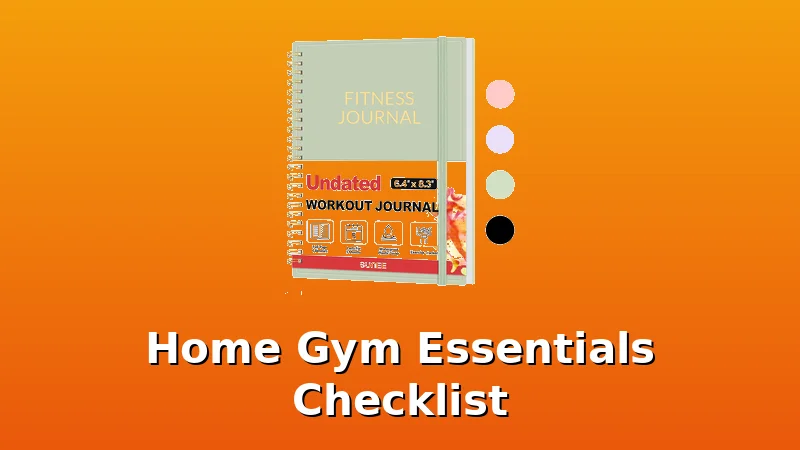
Best Overall: Fitness Journal Workout Planner
At $9.99, this is the one I kept reaching for. The A5 size is 6.4 x 8 inches, which is big enough to write legible notes but small enough to toss on a shelf without it becoming a landscaping project. The hardcover means it survives being thrown into a gym bag with a pair of chalk-covered straps.
The pages are undated, which is the detail that matters more than people think, you miss a week and you don't have to stare at a bunch of empty squares like a calendar judging you.
The layout has room for sets, reps, and weight, plus a notes section where I write things like "felt heavy, check sleep" or "left knee complained at 405, back off next week." That's the stuff that actually improves your training.
One verified owner wrote in March: "This same rack is sold under other names and colors," which is the white-label reality of Amazon.
The journal is the same way. I've seen this exact layout under three different brand names. The binding held up through six weeks of daily use, and the paper took pen without bleeding through.
For $9.99, that's worth every penny and then some.
Best Value: Anti-Slip Squat Mat
Here's the thing about squatting in a garage with a truck parked 18 inches away: the bar path matters, and so does your foot position. This mat at $9.99 is a flat piece of rubber with foot position markers printed on it, and it does exactly what it says.
I loaded up 300 pounds, set my feet on the markers, and the mat didn't move a millimeter. The rubber is thick enough to dampen the bar when you re-rack it, and it protects the concrete from the dents you get when you're tired and sloppy.
The markers are actually useful, which surprised me. I've seen these mats with marker placements that assume everyone squats with a shoulder-width stance and toes pointed perfectly at 30 degrees. This one has markers that are close enough to a real stance that I stopped thinking about my feet and started thinking about the lift.
One owner said it "works perfect!" and I get it. For less than ten bucks, it's the cheapest insurance you'll buy for your floor and your footwork.
Editor's Pick: Hardcover Fitness Journal
If you're the type who wants a journal that feels like a real book, this one at $13.99 is the upgrade. The paper is thicker, the binding lays flat when you open it, and the layout is clean without being sterile.
It's the same A5 format as the winner, but it costs four bucks more and the difference is in the feel.
The pages don't ghost when you write on both sides, which is a small thing until you've got a year of training notes and you want to actually read them.
The downside is the price. At $13.99, you're paying for the paper quality and the binding, not for anything that makes you stronger. If you're on a tight budget, the $9.99 journal does the same job. But if you're the type who keeps your logbooks on a shelf and flips through them to see how far you've come, this is the one.
It holds up better over a year of daily use, and the cover doesn't scuff the way the cheaper one does.
What else to consider
The budget pick: Palace Learning Dumbbell Poster. At $6.95, this is the cheapest way to get form cues on your wall. It's an 18x24 single poster with the basics, and it's fine. The print is clear, the paper is thin, and it'll curl in a humid garage unless you frame it. For the price, it's a starter.
The storage king: goremote Dumbbell Poster Set. This one is 2 posters at 18x24 each, which is a bigger footprint but better visibility from across the garage. At $9.95, it's a middle ground. The print quality is good, but you need wall space for two posters, and in a garage that's already Tetris-ed around a truck, that's a real consideration.
The wall-coverer: QCWN Dumbbell Poster Set. Six posters at 8x10 inches for $7.99. The smaller size means you can put them anywhere, but you'll need frames to keep them flat. The form cues are solid, and the variety is nice, but the paper is the thinnest of the three.
Should you buy the Fitness Journal?
Yes, if you're the type who writes things down. I've kept a logbook for fifteen years, and the difference between training with a log and training by feel is the difference between a planned progression and a guessing game.
At $9.99, this journal is the best value on this list. It'll last you months of daily use, it fits on a shelf, and it doesn't judge you when you miss a week.
The only reason to skip it is if you want the thicker paper of the $13.99 version, and that's a personal preference, not a performance difference.
Should you buy the Anti-Slip Squat Mat?
If you squat in a garage, on concrete, or anywhere with a hard floor, buy this. At $9.99, it's the cheapest gear on this list that actually protects you from a real injury. A foot that slides mid-squat is a foot that's about to dump a bar.
The markers keep your stance consistent, the rubber keeps your feet planted, and the price means there's no excuse.
The only reason to skip it is if you already have stall mats, and even then, the foot markers are useful.
Should you buy the Hardcover Fitness Journal?
This one's for the lifter who keeps their logbooks. If you've got a shelf with five years of training history and you like flipping back to see what you did at your last meet, the thicker paper and the lay-flat binding are worth the extra $4.
If you just want to write sets and reps and throw the journal in a drawer, save the money and get the $9.99 version.
Both do the job. This one just feels better doing it.
The bottom line
Here's what I've learned from nine racks and fifteen years of lifting: the gear that matters is the gear that shows up every day. A journal you actually use, a mat that keeps your feet planted, and a poster that reminds you where your elbows should be, that's the checklist.
The rest is marketing. Duke's laying on the stall mats right now, snoring, and I'm about to go squat.
The bar's loaded to 405, the safety bars are set, and my logbook's open to today's page. That's the whole setup.