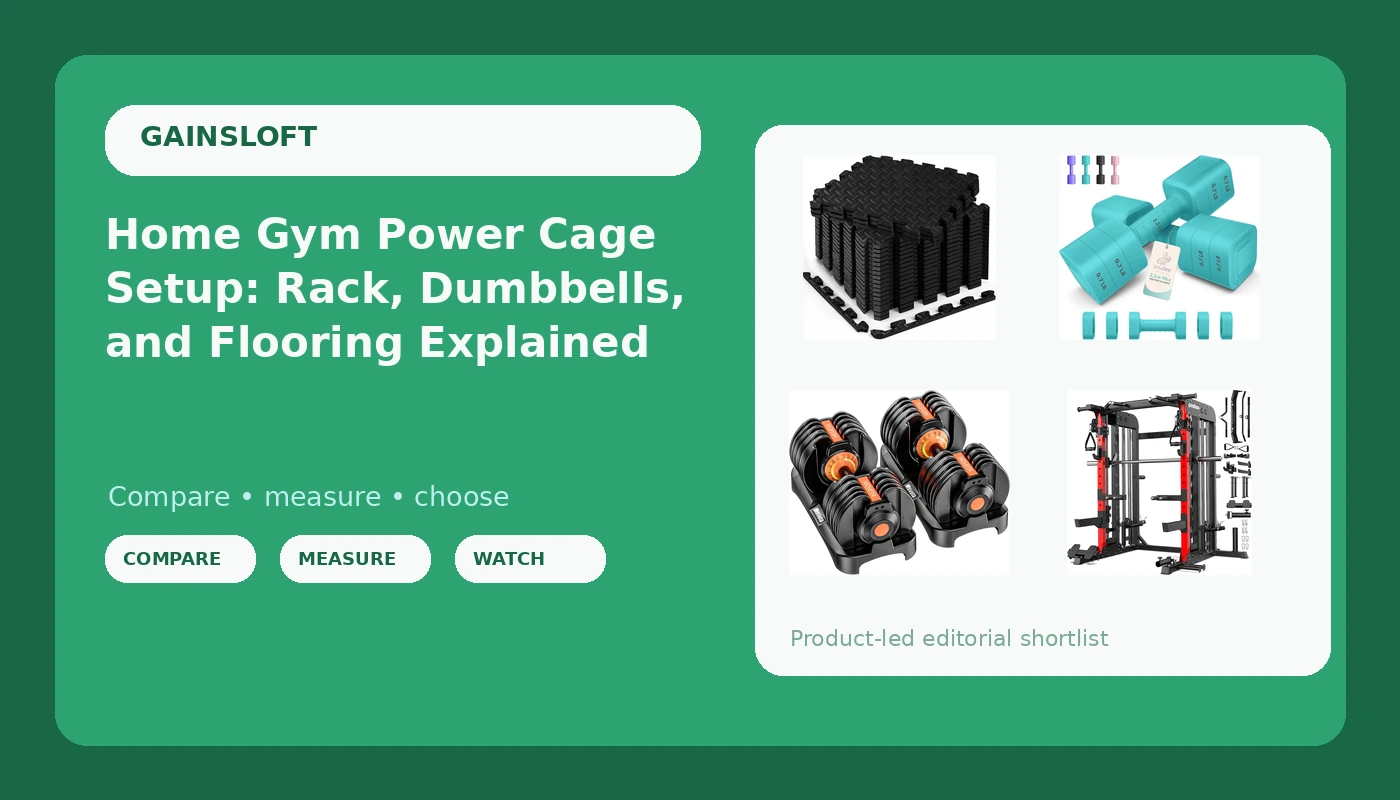
Most people building a garage gym start with the wrong question. They ask which rack is best, buy one, and then discover the floor is slick, the ceiling is an inch too low for a standing press, and the dumbbells already in the corner are too light for anything past a warm-up. A home gym power cage setup is really three purchases that have to work as one system: something that holds the bar and catches a missed rep, something that loads the muscles the bar does not reach, and something under your feet that keeps you from sliding when you drive out of the hole. Buy them in the wrong order and you pay twice.
What follows is not a ranking. It is an explanation of what each piece of a home gym actually does, what the spec sheets are telling you, and where the money matters. The four listings below cover those three jobs. One caveat runs through all of it: a capacity sticker is a claim, not a measurement.
Related: How Much Space Does a Home Gym Really Need? →
Quick answer
Buy the rack first, and buy more rack than your current squat needs, because the rack is the only piece of equipment in the room that has to catch you. Add adjustable dumbbells for the pressing and rowing the bar does not cover, and put something under the rack that grips instead of bare concrete. The four options below split those jobs, and none of them substitutes for another. If you only have budget for one purchase, spend it on the frame.
Four useful options
| Model | Best fit | What stands out |
|---|---|---|
| pooboo Power Cage Smith Machine with 2000LB Squat Rack Cable System | The centerpiece frame | Combines a power cage, a Smith machine carriage, and a cable system in one footprint |
| Adjustable Dumbbells Set of 2,Free Weights Dumbbells Set | Heavier accessory work | Sold as a pair of adjustable free weights rather than a single handle |
| Adjustable Dumbbell Set of 2, 2.2-20LB Adjustable Weight Set, 3 in 1 Free Weights Dumbbells Set for women men at home, 2.2lb, 3.6lb, 5lb,10lb, 20lb, for Home, Office, Gym Exercise Training, Anti-slip Handle | Light dumbbell and beginner work | Listed settings at 2.2 lb, 3.6 lb, 5 lb, 10 lb, and 20 lb with an anti-slip handle |
| 18 Pcs EVA Foam Floor Tiles, Puzzle Exercise Mat Set for Gym | Flooring under and around the rack | 18 interlocking EVA foam tiles with puzzle edges |
The rack: pooboo Power Cage Smith Machine with 2000LB Squat Rack Cable System
The pitch here is footprint efficiency. A power cage, a Smith machine carriage, and a cable system in one frame means you are not buying three stations and then finding room for three stations. In a garage or a spare bedroom, that math is hard to argue with.
The trade-off is that a Smith machine fixes the bar path. That is useful for certain movements and limiting for others, and a combo frame has more moving parts than a plain cage. If your training is built around a free barbell squat, bench, and deadlift, a simpler rack may serve you better. If you want one frame that covers squats, pulley work, and guided pressing, this is the shape to look at.
The number in the product name deserves a note. A stated capacity is a manufacturer claim. Before you trust it, look at the tube gauge, the weld penetration at the upright-to-base joints, and the grade of the bolts in the hardware bag. A tall frame is also a lever, so plan on bolting it down or loading the base. And measure your ceiling before the box arrives.
The dumbbell pair: Adjustable Dumbbells Set of 2,Free Weights Dumbbells Set
Dumbbells cover what a barbell does not: single-arm rows, overhead pressing without a rack, rear delts, lunges, carries. A set of two adjustable dumbbells is the right way to buy that, because one handle is half a workout.
The questions that matter with any adjustable dumbbell are the adjustment mechanism, the handle diameter, and how the plates lock to the handle. A dumbbell that rattles at the top of a press is a dumbbell you stop reaching for. Handle thickness also changes how a press feels, and a fat handle gets uncomfortable fast on heavy sets. Buy the pair, check the locking system the day it arrives, and treat the range as a tool for accessory work rather than a replacement for the bar.
The light pair: Adjustable Dumbbell Set of 2, 2.2-20LB Adjustable Weight Set, 3 in 1 Free Weights Dumbbells Set for women men at home, 2.2lb, 3.6lb, 5lb,10lb, 20lb, for Home, Office, Gym Exercise Training, Anti-slip Handle
This set is built around the light end of the range, with listed settings at 2.2, 3.6, 5, 10, and 20 lb per dumbbell and an anti-slip handle. That is a warm-up and high-rep tool. Rotator cuff work, lateral raises, curls, and the long finisher sets at the end of a session all live in that window.
Be honest about the ceiling. Twenty pounds per hand is a real limit for pressing and rowing, so if your accessory work is already past that, this set becomes a warm-up rack rather than a training tool. It is also a sensible entry point for someone starting from scratch, or training in a small space where a barbell is not an option yet.
The floor: 18 Pcs EVA Foam Floor Tiles, Puzzle Exercise Mat Set for Gym
Eighteen interlocking EVA foam tiles give you a surface that is not bare concrete. That matters more than people think. Concrete is unforgiving on dropped dumbbells and on your knees during floor work, and a slick sealed slab under a heavy squat is a slip waiting to happen.
Be clear about what foam does and does not do. It does not turn a garage floor into a weightlifting platform, it compresses under point loads, and it will not stop a rack from walking. If you bolt a rack through foam, the foam crushes over time and the bolt loses its preload, which is exactly when a frame starts to move. Use the tiles for protection and comfort around the rack, and keep the rack itself on something solid.
Prices and availability may change. Product images, names, and retailer links are matched to verified listings. No current price, rating, stock status, or measured result is stated here without current evidence.
What the steel gauge and the welds actually tell you
Steel thickness is the first honest number in any rack spec. Eleven-gauge steel runs about 0.12 inch thick, and it is the standard for racks that hold serious weight without flexing. Fourteen-gauge is noticeably thinner, and it is where most of the "1,000 lb capacity" stickers live. Gauge is measurable. A sticker is not.
Welds are the second number, and the one most people skip. Penetration is how deep the weld fuses into the base metal, and a bead that sits on top of a joint without fusing is cosmetic. Powder coat hides a cold weld beautifully, so look at the inside corners of the upright-to-base joints, the attachment points for the j-hooks and spotter arms, and the hardware bag. Grade 8 bolts are the expectation on a rack that claims a serious rating. Hardware store bolts are a warning sign.
How to read a capacity rating before you trust it
Capacity ratings are static numbers measured under ideal conditions. That is not how a rack fails in a garage. The real failure mode is lateral wobble under a heavy walkout, where the frame sways a few degrees, the bar starts moving, and your balance goes with it. A rack that holds 700 lb without moving is more useful than one rated at 1,000 lb that sways at 315.
Ratings also do not include the dynamic load of a failed rep landing in the safety bars, and they do not include your own body weight shifting against the uprights. Treat the rating as a ceiling to investigate, not a promise. The questions worth asking are where the wobble starts, whether the safety arms are rated to catch your working weight, and whether the frame needs to be bolted down to be honest about its numbers.
- Measure the space first: ceiling height at the tallest position you will use, floor footprint for the frame plus a loaded bar, and clearance behind the rack for loading plates.
- Decide whether you can bolt down. If you rent, or the slab is post-tensioned, plan for a heavier flat-foot frame and understand the stability you are giving up.
- Check the tube gauge before the sticker. Ask the seller, or measure the steel with calipers once the box is open.
- Inspect the welds and hardware on delivery day. Look at the inside corners, not the outside of the bead.
- Match the dumbbell range to the work you actually do. If your accessory pressing is past 20 lb per hand, buy the heavier pair.
Setting up the floor, the footprint, and the anchors
- Leave at least a bar's length plus room for a plate on each side of the rack, and more if you plan to load from the floor.
- Keep the rack off foam. Foam compresses, the frame settles unevenly, and a bolted rack can lose bolt preload as the tile crushes.
- Check the ceiling against your standing press and against any pull-up bar or cable attachment on the frame.
- If you bolt down, use the anchor spec for your slab type and re-check torque after the first few heavy sessions.
- Put the tiles where you drop dumbbells, kneel, and stretch. That is where foam earns its place.
Which option should you choose?
Choose the pooboo Power Cage Smith Machine with 2000LB Squat Rack Cable System when you want one frame to cover squats, guided pressing, and cable work, and you have the ceiling height and the floor space to anchor it. Choose the Adjustable Dumbbells Set of 2,Free Weights Dumbbells Set when you want a pair of free weights for pressing, rowing, and accessory work that the bar does not reach. Choose the Adjustable Dumbbell Set of 2, 2.2-20LB Adjustable Weight Set, 3 in 1 Free Weights Dumbbells Set for women men at home, 2.2lb, 3.6lb, 5lb,10lb, 20lb, for Home, Office, Gym Exercise Training, Anti-slip Handle when your work lives under 20 lb per hand, or when you are starting out and want a light adjustable pair. Choose the 18 Pcs EVA Foam Floor Tiles, Puzzle Exercise Mat Set for Gym when the floor under your rack is bare concrete and you want protection and grip around the frame.
None of these listings is a substitute for inspecting what arrives. Capacities are claims until you check the steel, and no product page can tell you whether a frame will wobble in your garage. Verify the gauge, the welds, and the hardware yourself, and treat the rating as the start of the conversation rather than the end of it.
The bottom line
Build the room around the rack, not the other way around. The rack is the piece that has to outlive everything else you own, so the gauge and the welds deserve more attention than the capacity sticker. Dumbbells handle the accessory work, and the right pair depends entirely on whether your pressing lives above or below 20 lb per hand. Flooring is cheap insurance for the concrete and your joints, but it is not a foundation. Get the frame right, then fill in around it.