
Related: Squat Rack vs Power Rack: Which One Belongs in Your Garage
I bought my first home gym power rack off a guy in Gastonia who was moving into an apartment. It was a two-post stand with hardware store bolts and a sticker that claimed 1,000 pounds. I squatted in it for a year. Then I loaded 405, watched the uprights walk two inches toward the wall, and sold it the same week. I spent four years as a welder's apprentice before I moved into industrial maintenance, and that year taught me more about steel than any spec sheet ever has.
Here is what I know now, after assembling, loading, and deliberately abusing nine racks in six years. A rack is not a piece of furniture with a weight rating printed on it. It is a structure. The steel, the welds, the hardware, and the floor under it all have to agree with each other, and when they do not, the disagreement happens at the exact moment you cannot afford it.
The four pieces below are what I would put in a Charlotte garage on a budget: two racks, one stand, and the flooring that keeps all of it from chewing up a concrete slab. I keep a grease-pencil logbook on every one of them, tube gauge to bolt torque, and the weight where the wobble starts.
What I check before I load a rack
I run every rack through the same four questions, in the same order. What gauge is the steel, measured, not read off a sticker. Where are the welds, and do they fuse into the base metal or just sit on top of it looking pretty. What happens at the rated capacity, does the frame wobble, bow, or hold. And would I let it catch a missed rep at my working weight, alone, at 6 a.m., with nobody else in the garage.
That last one is the whole job. The rack is the only piece of equipment in your gym whose failure mode is your spine. A bar that bends is a bad day. A rack that folds is a different conversation.
The steel thickness standard for serious racks is 11-gauge, roughly 0.12 inches. Anything thinner flexes under real loads, and flex becomes walk, and walk becomes a rack that has crept two inches toward the wall by the time you re-rack. You can feel that before you can see it.
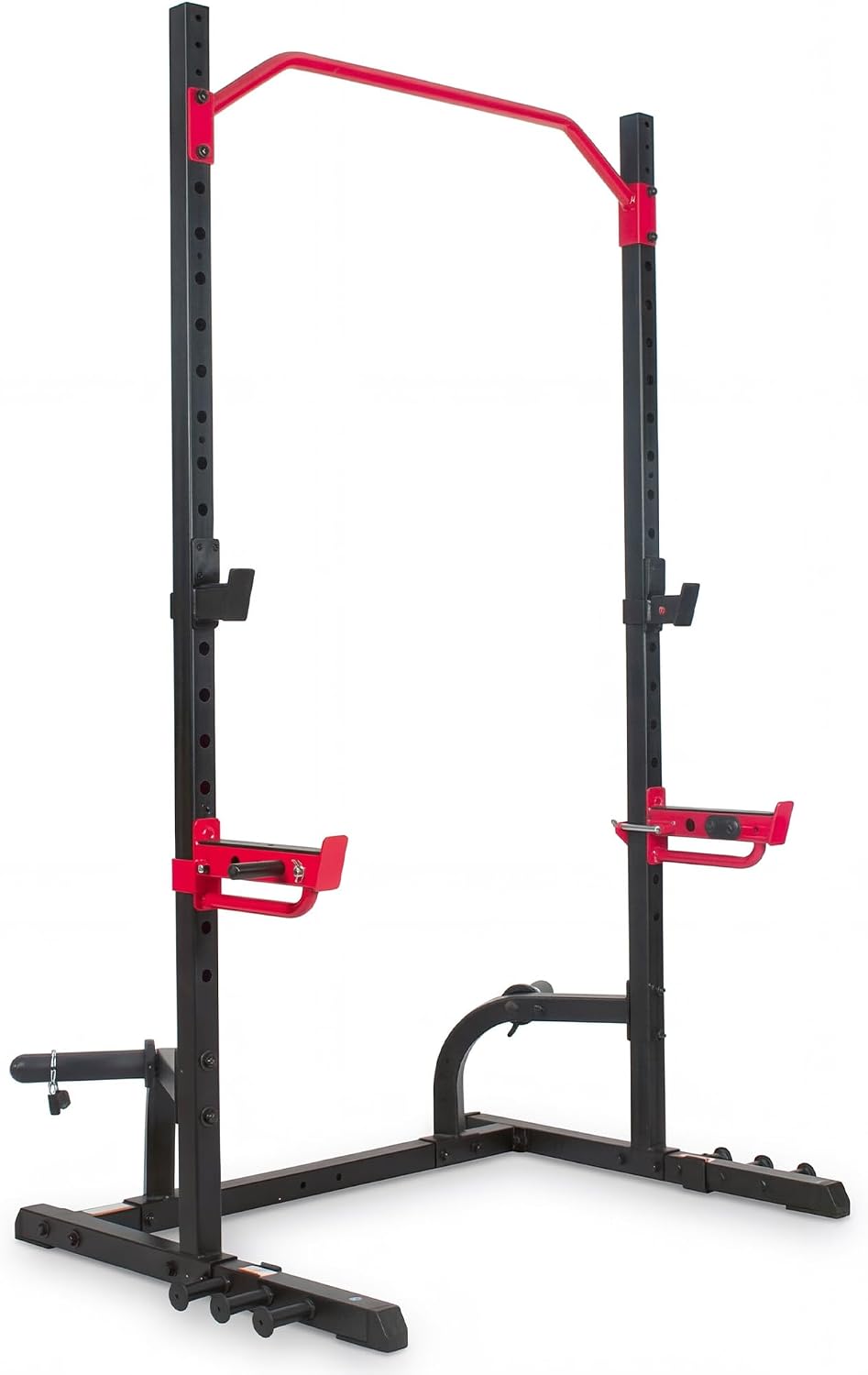
Sunny Health & Fitness Full Size Power Rack for Complete Strength Training
This is the one I would put in a garage where somebody trains alone and actually squats. A full-size cage is a different animal from a two-post stand. It surrounds you, which means the safeties are on both sides and a failed rep lands on steel instead of on you. I have failed a squat at 495. The rack caught it. That is the entire point of owning one of these.
Before you buy, do three things. Measure your ceiling with the bar in mind, not the rack. Measure your footprint with the bar loaded, which is wider than you think. Then get on the floor with a flashlight and look at the welds where the uprights meet the base, because that joint carries everything above it.
The hardware matters as much as the steel. If the box ships with soft bolts instead of grade-8, replace them before you load anything heavy, and torque them in a pattern, not one at a time. I keep a grease pencil mark on every bolt head so I can spot a loose one from across the garage.
CAP Barbell Power Racks and Attachments
CAP has been making budget barbell gear for a long time, and this is the package for someone who wants the rack and the attachments in one order instead of five. That convenience is real. The catch is that a bundle is only as good as the parts nobody photographs.
When a rack arrives with attachments, the attachment interface is what I check first. How does the j-hook sit on the upright. Does it tip when you re-rack crooked, because you will re-rack crooked at some point. Do the safety arms lock in solid, or do they rattle. A cheap hook that tips is not a cosmetic problem. It is a loaded bar rolling off a 60-inch upright onto your foot, and it happens to people who are tired, which is everybody at the end of a session.
I also read the capacity sticker against the steel. A number printed on a box is a legal document, not a fact. If a rack claims four digits and the tube looks like a fence post, believe the fence post.
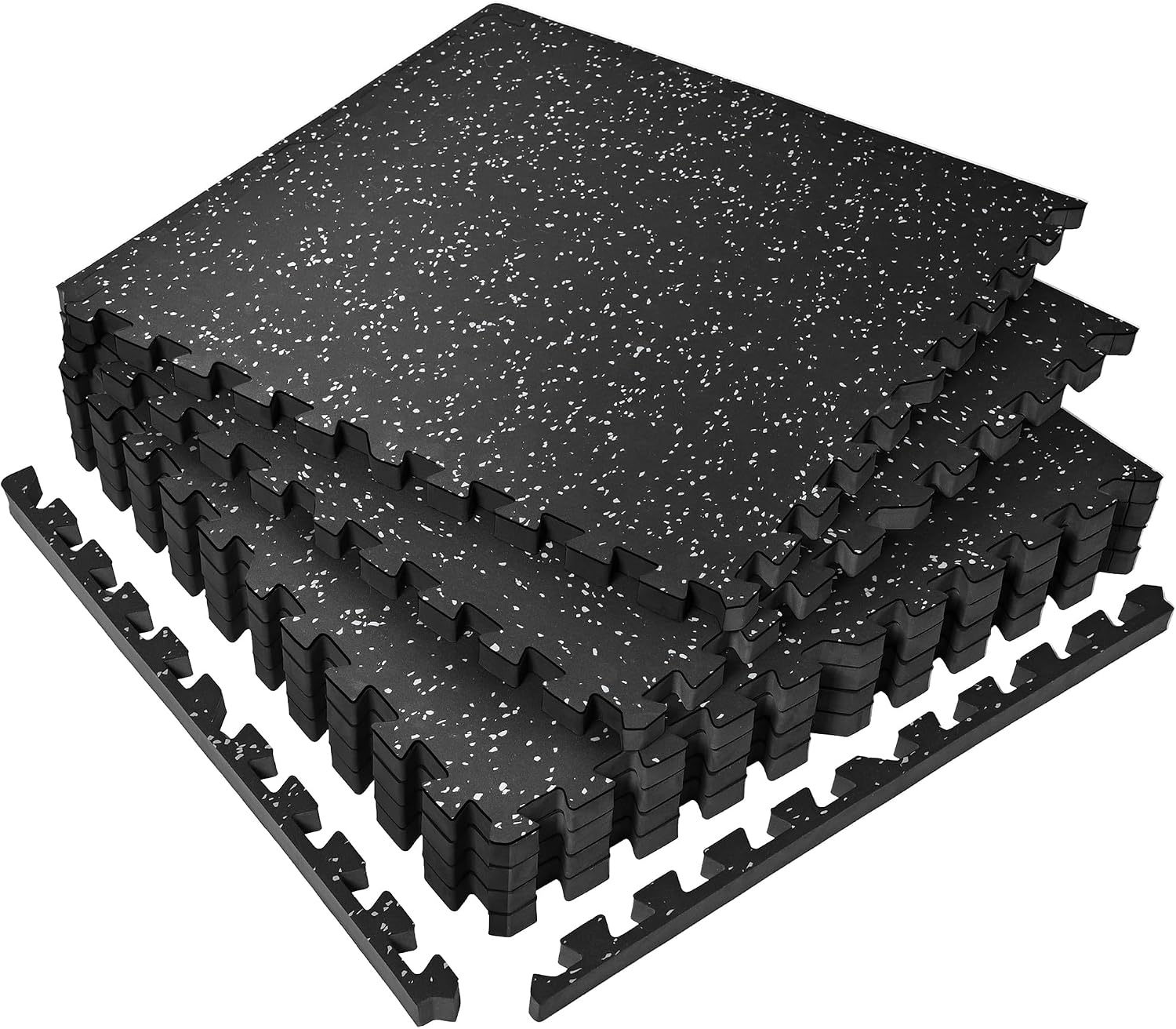
SUPERJARE 0.56'' Thick 24 Sq Ft Rubber Top Gym Flooring for Home Gym
Nobody buys flooring because it is exciting. You buy it because a dropped deadlift on bare concrete chips the slab, chews up plates, and makes your garage sound like a gunshot at 6 a.m. on a Tuesday.
This is rubber-top flooring, 0.56 inches thick, covering 24 square feet, which is enough for a rack footprint and the spot where your bar lands. The rubber top matters more than people give it credit for. It grips a rack foot, it grips a bench leg, and it does not turn into a skating rink when you sweat on it.
Two things I check. First, whether the pieces stay put once a loaded rack sits on them. Flooring that shifts under a rack foot is worse than no flooring, because now your rack is standing on something that moves. Second, how it handles a dropped plate. Rubber absorbs a bounce. Concrete returns it.
If your slab is uneven, level the rack, not the floor. Shim the feet, torque, and re-check after a week. Concrete and steel settle into each other, and a rack that was tight on day one is often loose on day thirty.
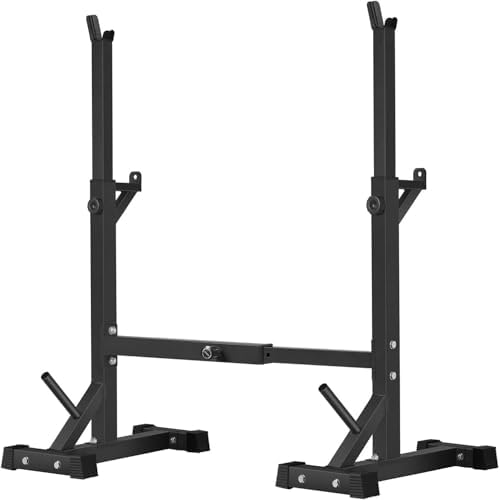
BangTong&Li Squat Rack Stand, Barbell Rack, Bench Press Rack Stand Home Gym Adjustable Weight Rack 550Lbs
This is the small-space answer. An adjustable squat stand takes up a fraction of the floor a full cage needs, and it moves when you do, which matters if you rent or if your garage still has to be a garage sometimes.
The rating on this one is 550 pounds, and I want you to read that number the way I do. A capacity rating is the weight the manufacturer is willing to stand behind, and it is usually the weight where the thing still works, not the weight where the thing is comfortable. If your working squat plus your bodyweight plus a little bounce from a failed rep gets close to the number on the sticker, you are asking a stand to be a cage.
That is not a knock on the stand. It is a knock on buying the wrong tool. If you squat 225 and bench 185 in a one-car garage, this is a sensible purchase and you will get years out of it. If you are chasing a 500 pound squat, buy the cage.
Check the adjustment pins, because that is the moving part, and moving parts are where budget stands fail. If the pins do not seat positively, if there is slop in the hole, that slop shows up as side-to-side sway the moment you unrack.
How I load a home gym power rack
I do not test racks by reading the box. I load them.
The protocol is boring and it works. Assemble it exactly as the manual says, then check every bolt with a torque wrench and mark it. Load the bar in steps, and at each step watch the uprights, the base, and the floor. I have a borrowed 6,000 pound jack stand and a concrete floor in Charlotte that is about to have a lot of anchor holes in it, and I use both.
At each weight I look for three things. Does the upright walk, meaning does the top of the rack move relative to the base. Does the frame bow, meaning does the steel flex and stay flexed. Does the hardware move, meaning do the bolts that were tight an hour ago now want a quarter turn.
The weight where the wobble starts is the number I write in the logbook. It is always lower than the sticker. That is not a scandal, it is physics, but you should know your own number before you are under the bar with no spotter.
Flat-foot racks give up some stability to a bolted base. That is a trade, not a flaw, and it is the right trade for a rental. If you can bolt down, bolt down.
The comparison table
| Product | Type | Best for | What I check first |
|---|---|---|---|
 Visit on Amazon → Visit on Amazon →Sunny Health & Fitness Full Size Power Rack for Complete Strength Training |
Full-size power rack | Lifters training alone at real loads | Weld penetration where the uprights meet the base, because that joint carries everything |
 Visit on Amazon → Visit on Amazon →CAP Barbell Power Racks and Attachments |
Rack plus attachments | Buyers who want everything in one order | The attachment interface, meaning how hooks and safeties seat on the uprights |
 Visit on Amazon → Visit on Amazon →BangTong&Li Squat Rack Stand, Barbell Rack, Bench Press Rack Stand Home Gym Adjustable Weight Rack 550Lbs |
Adjustable squat stand | Small spaces and moderate working weights | The adjustment pins, because slop in the holes becomes sway under the bar |
 Visit on Amazon → Visit on Amazon →SUPERJARE 0.56'' Thick 24 Sq Ft Rubber Top Gym Flooring for Home Gym |
Rubber-top gym flooring | Anyone lifting on a bare slab | Whether the pieces stay put once a loaded rack sits on them |
Where these four fit together
Two racks, one stand, one floor. Here is how they sort out.
The Sunny rack is the default. Full cage, full size, and it does the one job a rack has to do, which is catch a failed rep. If you have the ceiling height and the floor space, this is where the money goes.
The CAP package is for the person who wants the attachments handled in one purchase and does not want to shop for six months. Read the attachment interface carefully, replace soft hardware if you find it, and it will serve you.
The BangTong&Li stand is the small-space play, and it is honest about what it is. With a 550 pound rating, an adjustable frame, and a footprint you can fold a car around, it is a good tool for a lifter who is not yet chasing big numbers.
The SUPERJARE flooring is not glamorous and it is not optional in my book. A rack on bare concrete is a rack on a surface that will chip, and chipped concrete under a rack foot means a rack that no longer sits flat.
You do not need all four. You need the rack that matches your space and your working weight, and you need a floor that does not fight it.
Should you buy the Sunny Health & Fitness rack?
Yes, if you train alone and squat anything heavy. It is the only piece here that surrounds you, and the safeties are the reason you buy a cage instead of a stand. Measure twice, check the welds with a flashlight, and torque the hardware before the first heavy session.
Should you buy the CAP Barbell rack and attachments?
Yes, if you want one order to solve the whole problem. Go in knowing that a bundle lives and dies on its attachment interface, so inspect the hooks and safeties before you trust them with a loaded bar. If something feels soft, swap it.
Should you buy the BangTong&Li squat rack stand?
Yes, if your garage is small and your working weights are moderate. At 550 pounds rated, it is not a cage and it is not pretending to be. Respect the number and it will last. Ignore the number and you will find out what slop in a pin hole feels like at the bottom of a squat.
Should you buy the SUPERJARE flooring?
Yes. It is the cheapest insurance in the whole list. It protects the slab, it quiets the garage, and it keeps a loaded rack from sliding on a smooth surface. Buy it before you buy the second rack.