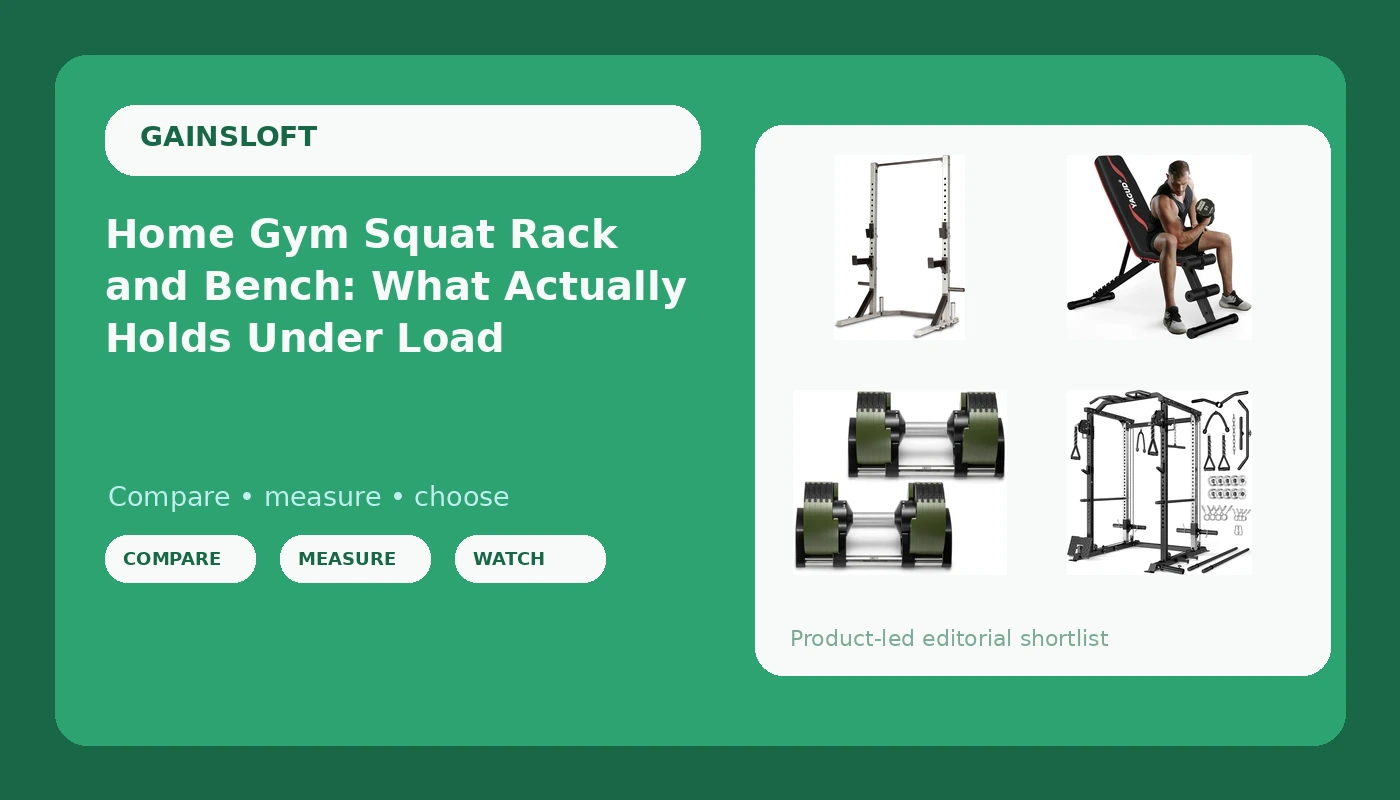
A home gym squat rack and bench setup is the one purchase where getting it wrong has consequences you cannot return. Racks and benches are the only pieces of equipment in a garage that exist to hold weight above your body, and they are also the pieces most often bought on the strength of a sticker that says 1,000 lb. This guide is not about which logo looks better in a garage photo. It is about four specific items, what each one actually does for a home lifter, and how to decide which combination covers your training without giving up floor space to equipment you will never touch. The DP01 Power Cage, the CAP Barbell FM-8000F Deluxe Power Rack, the Yagud Weight Bench Press, and the SMRTFT NUOBELL set cover the three jobs a home gym has to solve: squatting inside safeties, pressing on a stable surface, and loading dumbbell work without a wall of fixed weights.
Related: How to Read a Squat Rack Spec Sheet Without Getting Fooled →
Quick answer
Buy the rack first and let it set your budget. The DP01 Power Cage does the most jobs in one footprint, because the cable crossover and dual independent pulley system turn a full cage into a pressing and pulling station as well as a squat station. The CAP Barbell FM-8000F Deluxe Power Rack is the simpler route if you want a conventional cage and plan to choose your own attachments. The Yagud Weight Bench Press handles flat and incline pressing and folds for storage, and the SMRTFT NUOBELL set gives you 5 to 100 lb per hand in a pair that stores on a shelf. If you already own a rack, the bench and the dumbbells are the upgrades that change how you train. If you do not own a rack, nothing else on this list matters yet.
Four useful options
| Model | Best fit | What stands out |
|---|---|---|
| DP01 Power Cage | One purchase that covers squatting, pressing, and cable work | Full cage with cable crossover and dual independent pulley system, listed at 2,000 lb |
| CAP Barbell FM-8000F Deluxe Power Rack | Lifters who want a straightforward rack and will add their own attachments | Deluxe power rack design offered in a color series |
| Yagud Weight Bench Press | Small spaces where the bench has to disappear between sessions | Adjustable strength bench with a foldable frame |
| SMRTFT NUOBELL Adjustable Dumbbells | Dumbbell training without a rack of fixed weights | 26 settings in one pair, 5 to 100 lb, steel-knurled handle, 2-year warranty |
The full cage with cables: DP01 Power Cage
The trade-off here is footprint and assembly. A full cage with a cable system occupies more floor than a bare four-post rack, and independent pulleys add cables, sheaves, and attachment points that have to be assembled and checked before the first session. If you are working with a single parking space, measure twice. If you are not, this is the option that lets one machine cover squat, bench, overhead press, rows, and cable isolation without buying a second unit.
The conventional rack: CAP Barbell FM-8000F Deluxe Power Rack
The color finish is cosmetic and should not drive the decision. What matters is everything the finish hides: tube thickness, weld quality at the joints, the size and grade of the bolts in the bag, and whether the J-hooks sit flat against the uprights or tip when you re-rack a little crooked. A rack that ships without spotter arms or safety pins means you are choosing those separately, and that is fine as long as you actually choose them and check that they are rated above your working squat, not your bodyweight.
The adjustable bench: Yagud Weight Bench Press
A folding bench introduces a second joint to the structure, and joints are where benches move. That does not make a folding bench a bad choice, it makes the inspection more specific. Set it up, sit on it, and push sideways before you ever load it. Then check the same thing with a loaded bar at the incline position, which is the angle where the back pad and the hinge carry the most load. If the pad rocks or the frame flexes side to side under a load you actually press, that is your answer, and no capacity sticker overrides it.
The space-saving dumbbells: SMRTFT NUOBELL Adjustable Dumbbells
The honest trade-off with any adjustable dumbbell is that the mechanism is the weak point, not the handle. Adjusting takes a moment longer than grabbing a fixed pair, and the internal locking system is doing work that a solid cast dumbbell never has to do. Treat them like the precision tool they are: set them down under control, never drop them from overhead, and keep the adjustment mechanism clean. In exchange you get a 5 to 100 lb range per hand in a footprint smaller than a nightstand.
Prices and availability may change. Product images, names, and retailer links are matched to verified listings. No current price, rating, stock status, or measured result is stated here without current evidence.
What the steel actually tells you
Gauge is the number that decides whether a rack flexes at 315 or holds at 500. In rack construction, 11-gauge is the standard for serious equipment, roughly 0.12 inches of wall thickness, and 12-gauge is a small step down that most lifters will never notice. The trouble starts at 14-gauge, which is where budget racks live and where a 1,000 lb sticker becomes a legal document rather than a fact. You cannot measure tube thickness from a product photo, but you can usually find it in the listing details, and if a rack will not state its gauge, that silence is information.
Welds matter more than the powder coat covering them. A wide, even bead that ties the tube into the plate is what you want. A stack of cold, lumpy weld sitting on top of the joint without fusing into it will hold right up until it does not. Bolt grade matters too. Grade-8 hardware is the standard for a rack that sees real weight; hardware-store bolts are not, and swapping them is one of the cheapest upgrades you can make on any rack.
Finally, decide how the rack stays still. A flat-foot design sits on the floor unbolted, which is the right answer for a rental or a garage you might move out of. A bolted base is more stable, but only if the anchors go into concrete. Wall-mounted racks depend entirely on hitting studs dead center, and a top bolt that pulls out of drywall takes the whole rack with it.
Where a bench actually fails
Benches rarely fail on flat bench. They fail at incline, where the load transfers through the back pad into the hinge, and they fail sideways, when the frame twists instead of flexing front to back. That is why a bench that feels solid on flat can still feel like a different piece of equipment at 45 degrees.
Pop-pin and ladder-style adjustment systems both work, but a ladder with wide teeth and a pin that seats fully is less likely to develop play than a mechanism with a worn hole. Pad width and firmness matter more than most buyers expect: a narrow, soft pad rolls your shoulders and costs you stability before the bar ever gets heavy. And capacity claims deserve the same skepticism you apply to racks. A bench rated for 1,000 lb still has to survive a bar dropped on it from lockout, which is a far harder test than a static sticker.
- Measure ceiling height and floor space before you compare anything, including bar clearance at the top of a press.
- Write down your real working weights for squat and bench, then add a margin instead of rounding down.
- Decide between a full cage, a conventional rack, or a wall mount, based on whether you can bolt into concrete.
- Confirm the safeties: spotter arms or safety pins must be rated above your working squat, not your bodyweight.
- Choose the bench and dumbbells last, after the rack has claimed its footprint and its budget.
Practical guidance for a garage setup
- Put rubber flooring over concrete, and anchor racks into concrete rather than drywall or a stud you have not verified.
- Check the hardware bag on arrival and replace anything that is not grade-8 before the first heavy session.
- Leave clearance above the rack for a standing press, and leave clearance in front for a missed rep to travel.
- Budget in order: rack, bar and plates, bench, then dumbbells. Skipping ahead leaves you with weights and nothing safe to lift them in.
- If a car still has to park in the garage, a folding bench and an adjustable dumbbell pair are what make the room do double duty.
Which option should you choose?
Choose the DP01 Power Cage when you want one purchase to cover squatting, pressing, and cable work and you have the floor space for a full cage. Choose the CAP Barbell FM-8000F Deluxe Power Rack when you want a conventional cage and prefer to pick your own safeties and attachments. Choose the Yagud Weight Bench Press when the bench has to fold away between sessions, and choose the SMRTFT NUOBELL Adjustable Dumbbells when you want a 5 to 100 lb range per hand without a rack of fixed weights taking over the wall.
The one caveat that applies to all four: none of the ratings described here replace your own inspection. Set the equipment up, load it to a weight you can control, and check for movement before you trust it with a weight you cannot.
The bottom line
The rack is the piece that has to outlive everything else in the room, so it gets the budget first, and the safeties inside it get checked against your working squat rather than your ego. The DP01 Power Cage covers the most training in one footprint because the cable crossover and pulley system add pressing and pulling to a full cage. The CAP Barbell FM-8000F Deluxe Power Rack is the conventional alternative for lifters who would rather build the setup piece by piece. The Yagud Weight Bench Press handles the pressing angles and folds out of the way, and the SMRTFT NUOBELL set covers dumbbell work from 5 to 100 lb per hand. Buy in that order, check the welds and the hardware when the boxes arrive, and you end up with a garage that holds up at the weights you actually lift.