Buying a home gym squat rack and bench is the moment a garage stops being a garage and starts being a training space. It is also the moment most people make their most expensive mistake, because the two pieces of equipment that hold your body under load are the two pieces the market prices most aggressively at the bottom end. The problem is not that affordable racks and benches exist. The problem is that the numbers printed on the box, the capacity ratings, the tube thickness claims, the certification badges, are written to sell the box, not to survive a missed rep at your working weight. Before you compare anything, you need to know what you are actually paying for: steel, welds, hardware, and geometry. Everything else is marketing.
Related: How Much Squat Rack Do You Actually Need? →
Quick answer
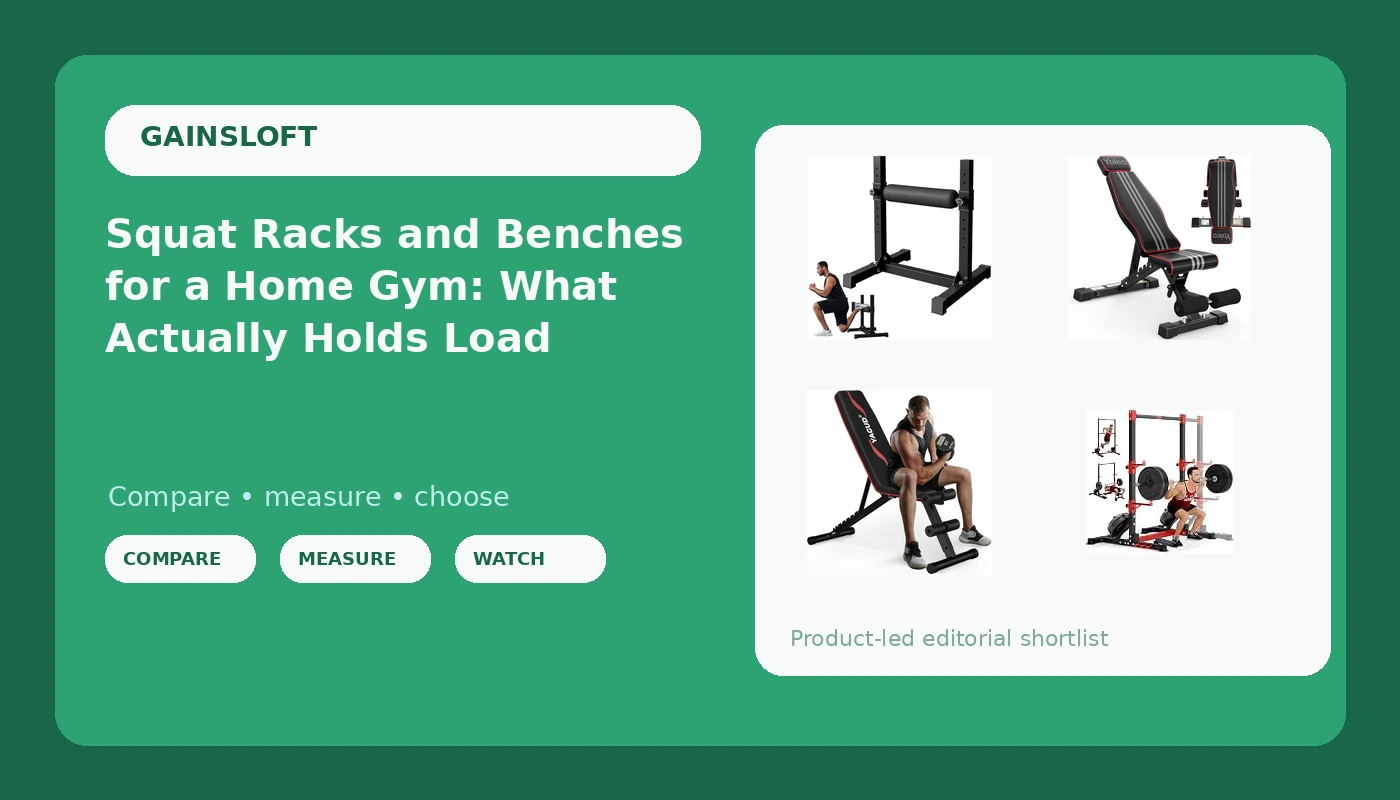
Buy the rack or cage first, the bench second, and add a specialty piece only after those two are stable. In this group, the YOLEO Smith Machine & Squat Rack Combo is the one frame that covers guided and free-weight work in a single footprint. The YOLEO Adjustable Weight Bench carries a stated ASTM certification and an 827 lb rating in its own product name. The Yagud Weight Bench Press is the foldable option for tight spaces, and the GMWD Bulgarian Split Squat Stand is a single-movement tool rather than a general-purpose rack. Match each piece to the job it was built for, then check the steel and hardware before you trust the rating.
4 useful options
| Model | Best fit | What stands out |
|---|---|---|
| YOLEO Smith Machine & Squat Rack Combo, Multi-Function Power Cage | Lifters who want guided and free-weight work in one frame | Combines a Smith machine, squat rack, and multi-function power cage in a single footprint |
| GMWD Bulgarian Split Squat Stand | Single-leg and lower body accessory work | Purpose-built single leg squat stand with a roller for rear-foot support |
| YOLEO Adjustable Weight Bench, ASTM-Certified 827LBS | Flat, incline, and decline pressing | Manufacturer states ASTM certification with an 827 lb rating |
| Yagud Weight Bench Press, Adjustable Workout Bench, Foldable Strength Bench | Small spaces where the bench has to disappear | Adjustable strength bench that folds for storage |
The all-in-one frame: YOLEO Smith Machine & Squat Rack Combo
The trade-off with any combo frame is that you are buying two tools in one body, and the frame has to serve both. A dedicated power rack puts all of its steel into four uprights and a pair of safety arms. A Smith machine adds a rail system and a carriage, which means more parts, more assembly, and more places for play to develop. That is not a reason to avoid it. It is a reason to treat the hardware as the product. Check the bolt grade, re-torque the frame after the first few sessions, and confirm the carriage tracks smoothly under load rather than dragging or catching. If the unit ships with generic hardware instead of graded bolts, that tells you where the money went. The guided bar path is also a genuinely different stimulus than a free barbell, so plan your training around that rather than expecting the Smith rail to replace a free squat.
The single-leg specialist: GMWD Bulgarian Split Squat Stand
Single-leg work is where most home gyms quietly fall apart, because the standard setup is a bench, a box, or a stack of plates holding a back foot that slides the moment you add real load. A dedicated stand solves that specific problem and nothing else, which is exactly why it belongs last in your buying order rather than first. It does not catch a failed squat, it does not hold a barbell, and it does not spot you. Treat it as an accessory tool: valuable if unilateral work is already in your program, dead weight if it is not. Before ordering, measure the footprint you can give it, since a specialty piece that has to be moved out of the way every session tends to stop getting used.
The adjustable pressing bench: YOLEO Adjustable Weight Bench, ASTM-Certified 827LBS
A bench fails in one place more often than any other: the incline position, with load on the bar and your upper back braced against a pad that is locked at an angle. Flat bench is the easy test. Incline is where the hinge, the locking pin, and the frame geometry are actually stressed. So when you evaluate any adjustable bench, set it to incline first, not flat. Sit on it, push against the pad, and look for side-to-side play and any rocking at the feet. A stated certification and a rating number are worth something, because someone had to put their name on the paperwork, but the sticker is not a substitute for checking the weld at the seat-to-frame junction and the grade of the pin that holds the pad angle. Also check pad width: a narrow pad feels fine in a showroom and miserable on a heavy set of presses.
The foldable space saver: Yagud Weight Bench Press
Any folding bench makes a trade: convenience in exchange for a joint that a fixed bench does not have. That joint is a wear point. A folding mechanism that locks up tight when new can develop play after a few hundred fold-and-unfold cycles, and play at the hinge shows up as rocking under your shoulders. Check how the fold locks, whether it uses a pin, a latch, or a collar, and whether there is any wobble when the bench is deployed. If it moves on flat bench with bodyweight alone, it will move more with a loaded bar. The payoff is real though: a bench that folds means a bench that stays in the garage instead of getting sold, and the best bench in the world is useless if it lives in a hallway closet because it eats too much floor.
Prices and availability may change. Product images, names, and retailer links must be matched by verified ASIN. Do not state a current price, rating, stock status, or measured result without current evidence.
What a capacity sticker actually means
Every rack and bench carries a number, and almost nobody reads it correctly. A capacity rating is a manufacturer's claim about the load the structure is intended to support under defined conditions. It is not a guarantee that the frame will hold that load in your garage, on your floor, with your assembly torque, after two winters of temperature swings. Two things have to be true before a rating is meaningful. First, the steel has to be thick enough to resist bending at that load. Second, the hardware has to be strong enough to keep the joints from loosening, because a bolted joint that loses preload stops behaving like a rigid connection.
This is where tube gauge and bolt grade matter more than any badge. Steel thickness is measured in gauge, and the number runs backwards: 11-gauge is heavier than 14-gauge. A rack built from thin tube can still carry a big sticker, because the sticker is a marketing decision, not a structural one. When you look at a frame, look for the wall thickness of the uprights, the size of the bolts, and whether the joints are welded or bolted. Then look at the welds themselves.
Steel, welds, and where racks fail
A weld is either fused into the base metal or it is sitting on top of it looking pretty. Penetration is the difference between a joint that transfers load through the parent metal and a joint that is essentially cosmetic. You cannot always see penetration through powder coat, but you can see its consequences: a weld with poor penetration tends to crack at the toe of the bead, right where the weld meets the tube. Look for uniform bead size, no undercutting along the edges, and no gaps where the upright meets the base plate.
The other failure point is the connection to the floor. A flat-foot rack stands on its own feet without bolting, which is the right answer for a rental or a garage where you cannot drill. A bolted base is stiffer, but only if the anchors are correct for the slab. A wall-mounted rack is the riskiest of the three, because everything depends on hitting studs dead center with anchors rated for the load. If you miss a stud, you are hanging a loaded barbell from drywall, and drywall does not care how good your program is.
Finally, safety: spotter arms and j-hooks are part of the load path. If the safety arms are rated below the weight you squat, they are decoration. If the j-hooks tip when you re-rack off center, that is a design flaw you will meet at the worst possible moment.
- Measure your space first, including ceiling height, and decide whether the rack can be bolted down or has to be flat-foot.
- Identify the heaviest load the rack will ever see, including a failed rep, and treat that number as the floor for any rating you accept.
- Inspect steel thickness and hardware grade before you accept a capacity claim, because the sticker is not evidence.
- Set any adjustable bench to incline and check for play before you trust it, since that is where benches actually fail.
- Buy the rack and the bench before specialty pieces, because a split squat stand cannot catch a missed squat.
Practical guidance for a garage setup
- Re-torque every bolted joint after the first week of use, then check again monthly for the first few months.
- Anchor the rack if you can. A flat-foot rack that walks an inch under load is telling you something.
- Give the bench the same load-path scrutiny as the rack, especially at the hinge and the seat junction.
- Match the tool to the job. A specialty machine earns its footprint only if the movement is already in your program.
- Keep the safety arms set just below your bottom position, so a failed rep lands on steel and not on you.
Which option should you choose?
Choose the YOLEO Smith Machine & Squat Rack Combo, Multi-Function Power Cage when you want guided and free-weight work from one frame and your garage cannot give up two footprints. Choose the YOLEO Adjustable Weight Bench, ASTM-Certified 827LBS when you need a pressing bench for flat, incline, and decline work and you want a stated certification and rating to start from. Choose the Yagud Weight Bench Press, Adjustable Workout Bench, Foldable Strength Bench when storage is the binding constraint and the bench has to fold away between sessions. Choose the GMWD Bulgarian Split Squat Stand, Single Leg Squat Roller, Single Leg Squat Stand, Lower Body Specialty Machine when single-leg work is already a fixed part of your program and a bench or box is no longer holding your back foot still.
One caveat applies to all four: nothing here replaces the verification step. A rating in a product name, a certification claim, or a capacity sticker describes what the manufacturer states, not what a loaded frame does in your garage on your slab with your assembly. Confirm the hardware, check the welds, load it progressively, and let the frame prove itself before you trust it with a rep you might miss.
The bottom line
The rack is the piece of equipment that has to outlive everything else you own, and the bench is the second-most dangerous thing in the room after it. That ordering should drive your budget. In this group, the YOLEO Smith Machine & Squat Rack Combo covers the most ground for a single-footprint setup, the YOLEO Adjustable Weight Bench brings a stated ASTM certification and an 827 lb rating to the pressing station, the Yagud Weight Bench Press solves the storage problem that kills most small-garage benches, and the GMWD Bulgarian Split Squat Stand handles one movement properly instead of several badly. Pick the piece that matches the training you actually do, verify the steel and hardware before you load it, and bolt it down if the slab lets you.