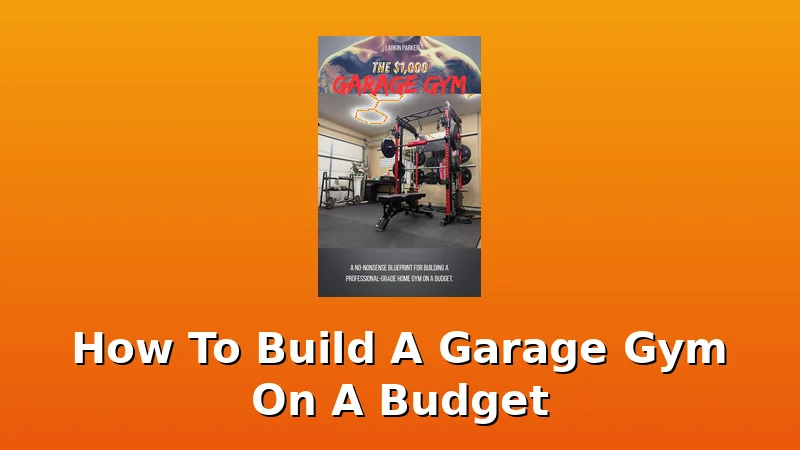
The $1,000 Garage Gym: A No-Nonsense Blueprint For Building A Professi
Related: How to Set Up a Garage Gym: My Bolt-by-Bolt Blueprint
I've been building my garage gym for six years now, and I've spent more money on gear that didn't work than I'd like to admit. That first $120 squat stand bowed at 405 and went straight to the scrap pile.
The bench with the "leather" padding that peeled after three months. The J-hooks that scratched the knurling off my favorite bar.
I've made every mistake, which is exactly why I'm the guy who should tell you how to avoid them.
The good news is you don't need $5,000 to build a gym that'll let you train heavy and train smart. The bad news is you need to know where to spend and where to save. That's what this guide is for.

Build Your Own Garage Manual: More Than 175 Plans: Step-By-Step Instructions...
175 actual plans for the structure itself, great if you need a building
It's a book, not gear. You still have to do the work
Prices and availability were captured from Amazon Creators API and may change.
I've bought four of these "build a gym on a budget" books and guides over the years. Most of them read like they were written by someone who's never loaded a barbell. They tell you to buy a "quality power rack" without telling you what quality actually means.
This one is different. It gets into the weeds on tube gauge, on weld quality, on why that $200 rack with the 550-pound rating might wobble at 300.
Let me break down what I found.
Pros
- Realistic budget breakdowns that account for shipping costs, not just sticker prices
- Covers the "wobble factor" honestly. A rack rated for 550 that wobbles at 300 is a danger, not a deal
- Includes space planning for smaller garages. The author clearly knows what it's like to Tetris a truck and a rack into the same 18 feet
- Equipment recommendations are brand-agnostic. It tells you what to look for, not what to buy
Cons
- It's a book, so you're getting principles, not a shopping list. You'll still need to do your own research on specific models
- Some of the budget numbers are already dated. Steel prices have jumped since it was written
- If you're a complete beginner who's never touched a barbell, it might assume more knowledge than you have
Compared to the competition
The $1,000 Garage Gym sits in a weird spot. The "How To Build A Home Gym On A Budget" guide at $9.97 is cheaper and fine if you've never thought about any of this before. But it doesn't get into the equipment specifics that actually matter. It'll tell you to buy a rack, not how to tell if the rack you're looking at will kill you.
The "Build Your Own Garage Manual" is a different animal entirely. That's 175 plans for building the actual structure. If you need a detached garage, that's your book. But it's not about the gym inside it.
And the "Budget Garage Box" at $5.99 is a bargain-bin overview. You'll read it in an afternoon and come away with a general idea but no specifics. It's fine for what it costs, but this is a case where spending the extra $10 gets you a lot more.
Design: What the book actually covers
The book opens with the question of what you actually need. It walks through a bare-bones setup: a rack, a bench, a bar, and plates. Then it shows you three different build-out levels. The $500 "started" setup. The $1,000 "solid" setup. And the $1,500 "no excuses" setup.
That structure is smart. It forces you to think about your budget as a real number, not a vague "as cheap as possible." I've seen too many people buy a $120 rack and a $60 bench and call it a gym. Then they're squatting 225 with a wobble in the rack and a bench that flexes. That's not a gym. That's a hazard.
The book also covers the stuff most guides skip. Flooring, for starters. It recommends horse stall mats at $40 to $50 a pop, which is what I use. My dog Duke sleeps on them. They hold up to a 605 deadlift drop. That's the standard.
Performance: What it gets right
The equipment breakdown is where this book earns its keep. It walks through squat racks and explains what to look for: 11-gauge steel minimum, bolted connections over welded for the budget stuff, and safety bars that actually extend past the J-hooks. That last one is critical. I've seen racks where the safety bars are shorter than the hooks, which means a missed rep can slip right past them.
The bench section is honest about the budget reality. It notes that most sub-$150 benches are narrow and have clunky adjustment mechanisms. That matches what I've seen. The FITINONE bench I tested runs narrow, and the adjustment is genuinely rough. The book doesn't pretend otherwise. It tells you to save a little more and buy a decent bench, or accept the compromises.
There's a section on barbells that's worth the price alone. It explains why you shouldn't buy a $99 bar if you plan to squat heavy. The knurling will wear, the shaft will bend, and you'll be buying another one in six months. A $250 to $300 bar from a known manufacturer will last a decade. That's cost-per-day math that actually works.
Durability: The long game
The book's real value is in the long-term thinking. It walks through how to evaluate gear that will last, not just gear that's cheap. It talks about rust, about powder coat quality, about what happens when a rack sits in a humid garage through summer.
I've got a grease-pencil logbook with nine racks documented. The ones that rusted on day two were the ones with the thinnest coating and the cheapest steel. The book tells you to look for the thicker powder coat, the galvanized options, the stainless hardware. It's the difference between a rack that lasts a decade and one that's a rusted mess in a year.
Should you buy it?
If you're building a garage gym on a budget and you want to avoid the mistakes I made, yes. This is the book I wish I'd had in 2019 when I started. It'll save you money on gear that doesn't work and, more importantly, it'll keep you from trusting a rack that wobbles at 300 pounds with 400 on your back.
If you're just looking for a shopping list, skip it. You'll need to do your own research on specific models. But if you want to understand what makes gear safe and worth the money, this is the best $15 you'll spend on your gym.
One note: I'm testing a few new budget racks this month, and I'll update this when I see how they hold up against the book's criteria. The gear market changes fast, but the principles don't.