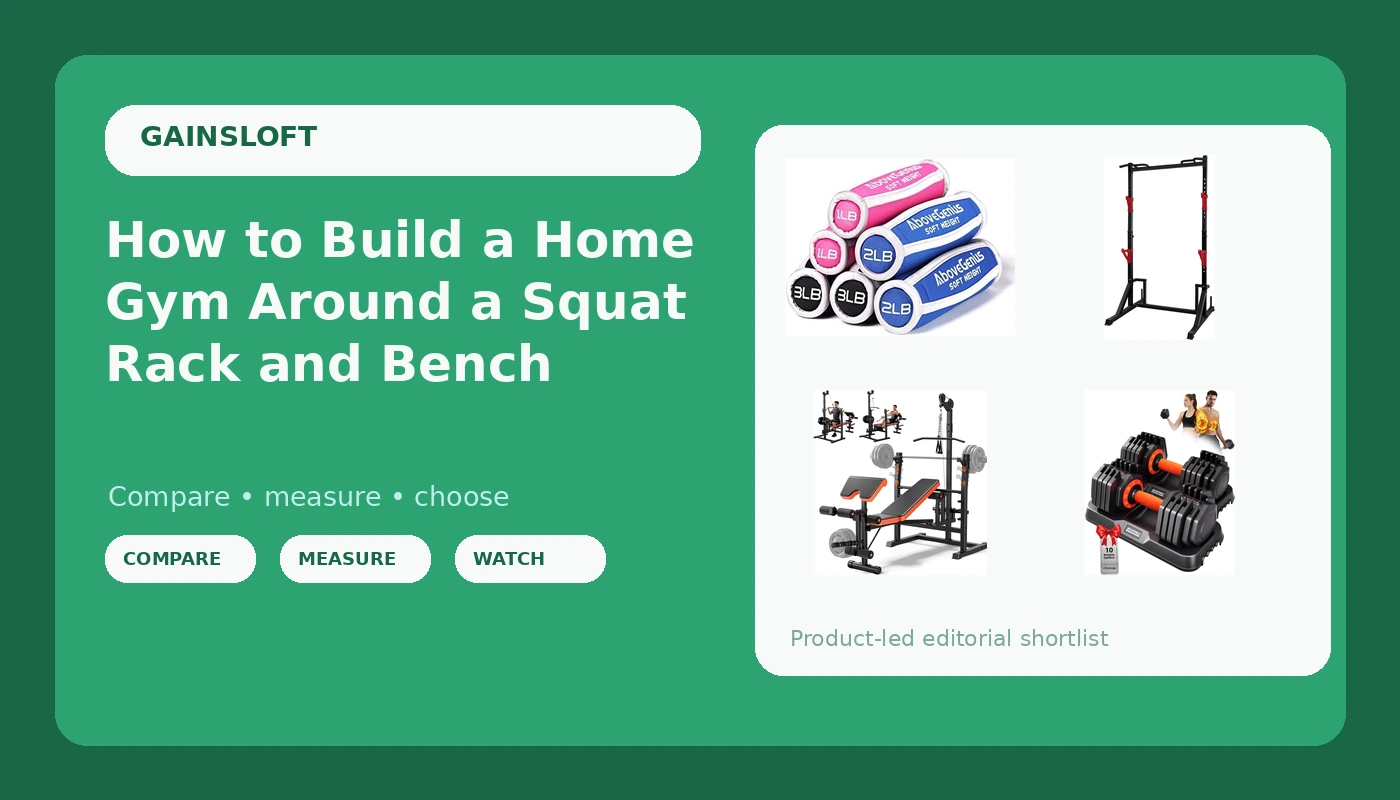
Most home gym advice starts with the barbell, and that is backwards. A barbell is cheap to replace and easy to store in a corner. A rack is neither. A rack that shifts under a heavy squat turns every rep into a negotiation, and a bench that flexes on an incline is the second-most dangerous object in the room after a bad spot. This explainer covers the four pieces that make a basic home gym squat rack and bench setup work: a multifunction power rack, a multi-station bench with lat pulldown and leg curl, a pair of adjustable dumbbells, and a light soft hand weight set for warm-ups and rehab. Each entry is here because it fills a distinct role in the room, not because it won a head-to-head test.
Related: Squat Rack Buying Checklist: Gauge, Welds, and Anchors →
Quick answer
Buy in this order: rack first, bench second, dumbbells third, light hand weights last. If you can only buy one thing this year, buy the rack, because it is the only piece in the room that catches a failed rep and nothing else substitutes for it. The other three pieces widen what you can train. They do not change whether you can train safely.
Four useful options
| Model | Best fit | What stands out |
|---|---|---|
| CANPA Multifunction Power Rack with Pull up Bar, Heavy Capacity and Adjustable Squat Stand Rack for Home Gym Equipment, Power Rack Cage | A first rack for a garage or spare room | Squat stand, cage, and pull-up bar combined in one frame |
| Fostoy Olympic Weight Bench with Lat Pulldown, Squat Rack & Leg Curl | One station that covers pressing, pulldowns, and leg work | Bench, lat pulldown, squat rack, and leg curl in a single unit |
| Adjustable Dumbbell Set 25lb/50lb, 10 in1 Adjustable Dumbbells for Home Gym | Small-space upper body and accessory work | One pair replaces a whole rack of fixed dumbbells |
| AboveGenius Soft Hand Weights Set, 12/18 lb Walking Dumbbells (1/2/3/4lb) | Warm-ups, walking, and light rehab work | Soft shell and light loads, sold as a set with several pairs |
The rack: CANPA Multifunction Power Rack
The rack is where the money goes and where the shortcuts hide. Two things decide whether a rack is worth the floor space it takes up: the thickness of the steel in the uprights, and the quality of the welds where those uprights meet the base plates and crossmembers. A powder coat can make a thin tube look substantial in a photograph. It cannot make it stiff.
When you look at a rack listing, read the tube gauge before the capacity number. A capacity sticker is a claim about a design under ideal conditions. Tube gauge is a physical property you can verify with calipers once the box is open. If a rack names a heavy capacity but will not state the gauge, treat the capacity number as marketing until you have the steel in your hands. The same logic applies to hardware: grade-8 bolts hold torque, hardware store bolts stretch.
The CANPA unit is a cage with an adjustable squat stand and a pull-up bar built into the same frame, which is the practical layout for a garage where you want one structure to do several jobs. The trade-off with any multifunction frame is that you are buying versatility rather than a single-purpose platform. Check the upright spacing, the hole pattern, and whether the frame is meant to sit flat-foot or be anchored. If you plan to anchor it, confirm your concrete can take the holes before you drill.
The bench: Fostoy Olympic Weight Bench
The bench is where people cheap out, and it is the piece that fails in the position you least expect. Flat bench is not the test. Incline is the test, because that is where the back pad and the seat meet, and where a weak hinge shows itself as side-to-side movement under load. A bench that walks sideways while you are holding a loaded bar over your face is a problem no capacity sticker solves.
A multi-station bench like the Fostoy makes a different trade than a dedicated adjustable bench. You get a lat pulldown, a squat rack section, and a leg curl in one footprint, which is a lot of training coverage for a room that cannot hold four machines. What you give up is the single-minded rigidity of a bench that does one thing. Before you load it, check the pad width, check how the incline mechanism locks, and check how the squat rack section is braced against the bench frame. Multi-station frames concentrate stress at the joints, so the joints are what you inspect.
There is also a sequencing question. If you own a full power rack, a bench like this duplicates part of what the rack already does. If you do not own a rack yet, a multi-station bench can cover squatting and pressing while you save for one, as long as you respect its limits and use the safety provisions the frame provides.
The dumbbells: Adjustable Dumbbell Set 25lb/50lb
Adjustable dumbbells are the answer to a real problem: a fixed dumbbell set from 5 to 50 pounds takes up more wall space than a rack and costs more than both. The adjustable pair collapses that into a single shelf. The cost is handling. You change weight between sets, and if the mechanism is fussy, you stop changing weight and your training quietly narrows to whatever load is already on the handle.
When you evaluate an adjustable set, look at three things. First, the handle diameter, because a thick handle limits grip work more than people expect. Second, how the plates lock, since a plate that shifts mid-set is both a distraction and a hazard. Third, the drop tolerance. Adjustable dumbbells are not urethane fixed dumbbells and should not be dropped from overhead or thrown onto concrete. Set them down.
The 25 lb and 50 lb configurations cover a wide range of accessory work: rows, presses, curls, lateral raises, split squats, and carry variations. They do not replace a barbell for heavy squatting or pulling, and they are not meant to. In a room that already has a rack and a bench, they are the piece that fills the gaps between barbell sessions.
The light weights: AboveGenius Soft Hand Weights Set
Not every purchase in a home gym needs to be load-bearing equipment. Light soft hand weights have a narrow but genuine job: shoulder warm-up circuits, arm work during walks, and the early stages of rehab where a hard steel handle is uncomfortable and unnecessary. The soft shell also means they can be set down on a wood floor or a treadmill deck without chewing it up.
Be honest about the ceiling here. A set in the 1 to 4 lb range per pair is not a substitute for dumbbells and is not meant to be. It is a warm-up and movement tool. If you find yourself trying to make light hand weights into a main lift, the adjustable dumbbells are the piece you actually need.
Prices and availability may change. Product images, names, and retailer links are matched to verified listings. No current price, rating, stock status, or measured result is stated here without current evidence.
What gauge and weld quality actually mean
Two numbers decide how a rack behaves under load, and neither one is the capacity sticker.
Gauge refers to steel thickness, and the numbers run backwards: a lower gauge is thicker steel. An 11-gauge upright is roughly 0.12 inches of wall thickness. A 14-gauge upright is noticeably thinner and will flex earlier under the same load. You cannot see the difference through a powder coat, which is exactly why a coat is the last thing to look at and calipers are the first.
Weld quality is the second number, and it is harder to judge from a photo because a pretty bead and a strong bead look similar at a distance. What matters is penetration: how deeply the weld fused into the base metal rather than sitting on top of it. The joints that matter most are where the uprights meet the base plates, where the crossmembers tie the frame together, and where the j-hooks are built. A rack is a system, and a rack is only as stiff as its weakest joint.
Capacity ratings are claims, not measurements. A sticker that says a frame holds a thousand pounds tells you what the seller is willing to assert. It does not tell you the gauge, the bolt grade, or whether the rack will walk across the floor at your working weight. Read the gauge, inspect the joints, then decide what you believe.
How to match equipment to your working weight
- Write down your heaviest actual working squat and bench, not the number you hope to hit next year. Buy for the weight you train now, with a margin above it.
- Check the tube gauge on the uprights before you read the capacity sticker. If the gauge is not published, that is information too.
- Inspect the joints: upright to base plate, crossmember connections, and j-hook construction. Those are the places a frame fails first.
- Decide whether the rack will sit flat-foot or be anchored, and confirm your floor or concrete slab can take anchors before you commit to a bolt-down design.
- Load it in stages when it arrives. Empty bar first, then half your working weight, then your full working weight, checking for movement at each step before you add more.
Practical guidance before you order
- Measure your ceiling height before buying anything with a pull-up bar, and account for your own reach above the bar.
- Measure the footprint of the cage against your platform or mat area, including the depth you need to walk a bar in and out.
- Match your bench height to your rack's j-hook height so you can unrack a press without shrugging off the pins.
- Keep the light hand weights near the door where you will actually use them for warm-ups, not buried behind the rack.
- Budget for flooring and anchors before you budget for accessories. A rack on bare concrete is a rack that slides.
Which option should you choose?
Choose the CANPA Multifunction Power Rack with Pull up Bar, Heavy Capacity and Adjustable Squat Stand Rack for Home Gym Equipment, Power Rack Cage when you are setting up a first serious home gym and want one frame to cover squatting, pressing, and pull-ups. Choose the Fostoy Olympic Weight Bench with Lat Pulldown, Squat Rack & Leg Curl when you have room for one multi-station unit and want pressing, vertical pulling, and leg work in the same footprint. Choose the Adjustable Dumbbell Set 25lb/50lb, 10 in1 Adjustable Dumbbells for Home Gym when space is tight and you need a wide range of accessory loads without a wall of fixed dumbbells. Choose the AboveGenius Soft Hand Weights Set, 12/18 lb Walking Dumbbells (1/2/3/4lb) when you need light loads for warm-ups, walking, or early rehab work and nothing heavier.
The caveat is the same for all four: a listing describes a design, and a design is not the same as a verified result. None of the claims above are statements about measured performance. Before you load any rack or bench, check the gauge, check the joints, check the hardware, and test with a light bar before you test with your working weight.
The bottom line
A home gym is built in an order, and the order is rack, bench, dumbbells, light weights. The rack carries the safety burden, the bench carries the second-largest risk, and the dumbbells and hand weights fill in around them. Buy the stiffest frame you can afford, verify the steel rather than the sticker, and treat every capacity claim as something to check rather than something to trust. The equipment that outlives everything else you own is the equipment that was never asked to be impressive, only to hold.