Related: Best Budget Squat Rack for a Garage Gym
A rack that wobbles at 315 will not save you at 405. That is the rule I build every home gym squat rack and bench recommendation around, and it is why I care more about tube gauge and weld penetration than I care about powder coat color or how the logo looks on the uprights.
I spent four years as a welder's apprentice before I moved into industrial maintenance, and I have been squatting in a Charlotte garage since my old gym doubled its membership price in 2019. Over the last six years I have assembled, loaded, and deliberately abused nine squat racks, including one that bowed at 405 and a wall mount that pulled its top bolts straight out of a stud. I keep a grease-pencil logbook on all of them: tube gauge, weld quality, bolt hardware, and the exact weight where the wobble starts. That logbook is why I can tell you which of the four setups below is worth your money, and which one is a sticker pretending to be a rating.
The four listings here cover the realistic range of a 2026 garage gym: two HULKFIT power racks with lat pulldowns, a C1-V4 Pro power cage with a leg hold-down for lat pulldowns, and a YOLEO bench set. None of them is the rack I would put under a 600 lb squat. Here is how I sort them, and what I would check before I bolted any of them down.
Best Overall Rack: HULKFIT Power Rack with Lat Pulldown
Two listings in this guide carry the identical HULKFIT name, and that is the first thing to sort out. The higher-priced of the two is the one I would anchor a garage gym around: a four-post power rack with the lat pulldown built into the frame, so your squat stand and your cable station share one footprint. In a one-car garage, shared footprint is not a convenience. It is the difference between training and tripping.
The reason I put this one first is the pulldown. A pulldown bolted to the outside of a cheap squat stand is a lever, and levers twist frames. When the pulldown is part of the rack itself, the load path runs down the uprights and into the feet instead of pulling the whole thing sideways. That is the design logic I want, and it is the reason a rack like this can do double duty without walking across the floor mid-set.
What I would check before assembly: run a thumb along the inside of every corner weld and feel for a bead that sits on top of the steel instead of fusing into it. A pretty bead with no penetration is a lie wearing a tuxedo. Check the bolt bag for grade-8 hardware rather than hardware-store bolts, then put a level on both uprights and confirm they are parallel before you torque anything down. A rack bolted together out of square will never sit flat, no matter how many times you loosen and re-tighten it.
Best Value Rack: the Lower-Priced HULKFIT Power Rack with Lat Pulldown
Same name, lower cost, and that is worth understanding before you assume you are getting an identical rack for less money. These are two separate listings on the same platform family, and the cost gap is telling you something about the build level. Confirm which listing is actually in your cart before you click buy, because the names will not help you tell them apart.
This is the rack I would hand to someone building their first garage setup, especially if they were also budgeting for a bar and plates. The integrated lat pulldown means you are not buying a separate cable tower, which saves both money and floor space. What you give up at this price is margin: the difference between a rack that shrugs at your working weight and one that still has headroom above it.
If your squat lives under 315 lb and you are not planning to move it much past that, this is a lot of rack for the money, and it will hold a bench press, a row, and a pulldown without complaining. If you are chasing a 405 squat, put the difference into the heavier HULKFIT listing and thank yourself in two years. The rack is the one piece of equipment in your garage that has to outlive everything else you own.
Best Cage: C1-V4 Pro Power Cage Squat Rack with Leg Hold-Down for LAT Pulldowns
Cage format, wider footprint, and a leg hold-down that separates it from the racks above. A leg hold-down pins your thighs so you can pull heavy lat work without your body drifting up off the seat. If you have ever finished a set of pulldowns and realized you were standing up instead of pulling down, you already know why that matters. On a cage, the pulldown station is usually the tallest point of the frame, which means it is also the place where a sloppy build shows up first.
The trade-off with a cage is square footage. A cage is not something you tuck into a corner and forget. It wants real floor space and it wants to be level, and most garage floors slope toward the door. That means shimming the feet before you load a bar, then checking the shims again after a month of use. Do that job once, properly, and a cage becomes the most forgiving platform in a home gym, because you can squat, press, and pull inside the same box.
Two checks specific to this format. Measure the cage depth against the length of your bench, so your bench actually fits inside for a racked press. And check where the hold-down pins land on your legs, not where they would land on a shorter or taller lifter, because a hold-down that hits your knee instead of your thigh is a bruise generator.
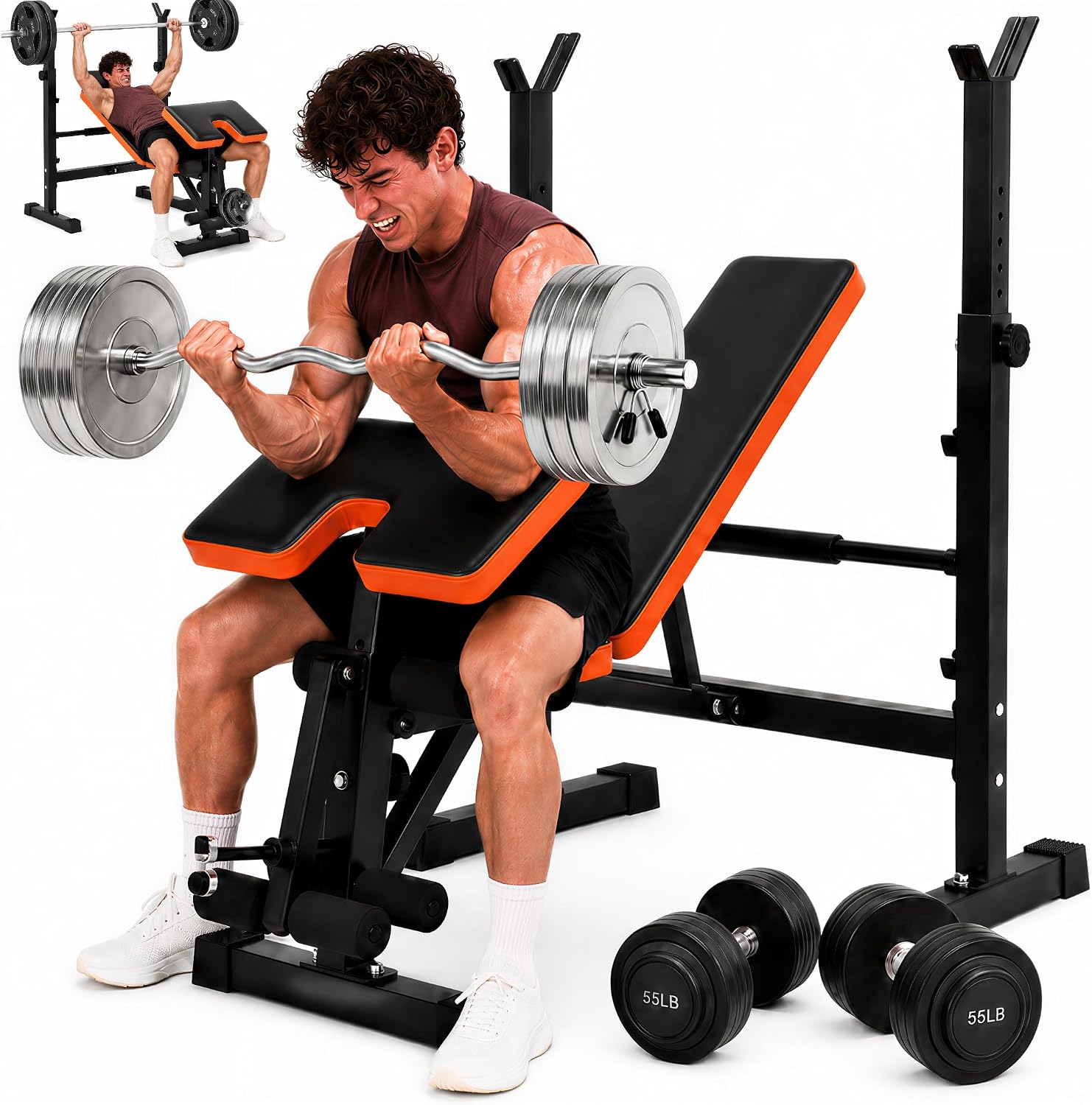
Best Bench: YOLEO 880-1980LBS ASTM-Certified All in One Weight Bench Set
The bench is the second-most dangerous thing in a home gym after the rack, and it is where almost everyone cheaps out. The YOLEO listing advertises ASTM certification and a capacity range that runs well past anything a home lifter will put on it. I do not repeat a capacity number as though it were a fact, because a sticker is a legal document, not a measurement. What actually matters is whether the frame stays rigid in the position where benches fail, which is incline, under load, with the pad carrying your shoulders and your feet driving into the floor.
The all-in-one part is the real appeal for a single-car garage: one bench covering flat work, incline work, and leg work means less gear to store and less gear to trip over. Understand the trade, though. Every attachment on a combination bench is a joint, and every joint is a place where flex starts.
So test the pad for side-to-side play before you trust it with a heavy press, and check the frame at incline rather than flat, because flat is the easy position. Pair this with either HULKFIT rack and you have a complete pressing and squatting station for less than the cost of most single-purpose benches plus a separate leg machine.
The reference table: matching the gear to the garage
| Setup | Best for | What I check first | Notes |
|---|---|---|---|
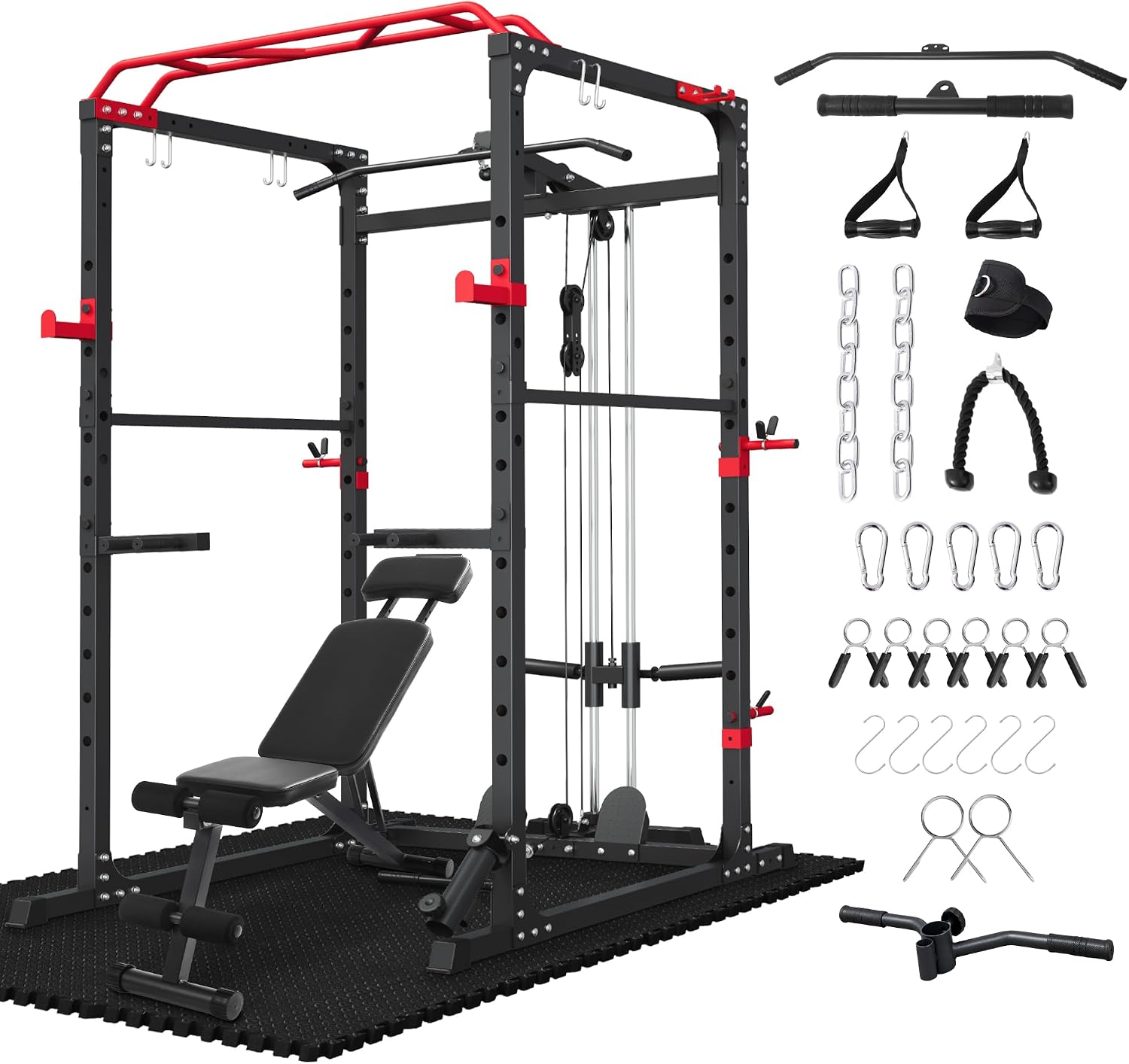 Visit on Amazon → HULKFIT Power Rack with Lat Pulldown |
Squatting and pulling in one footprint | Weld penetration at the top corner joints | The higher-priced HULKFIT listing |
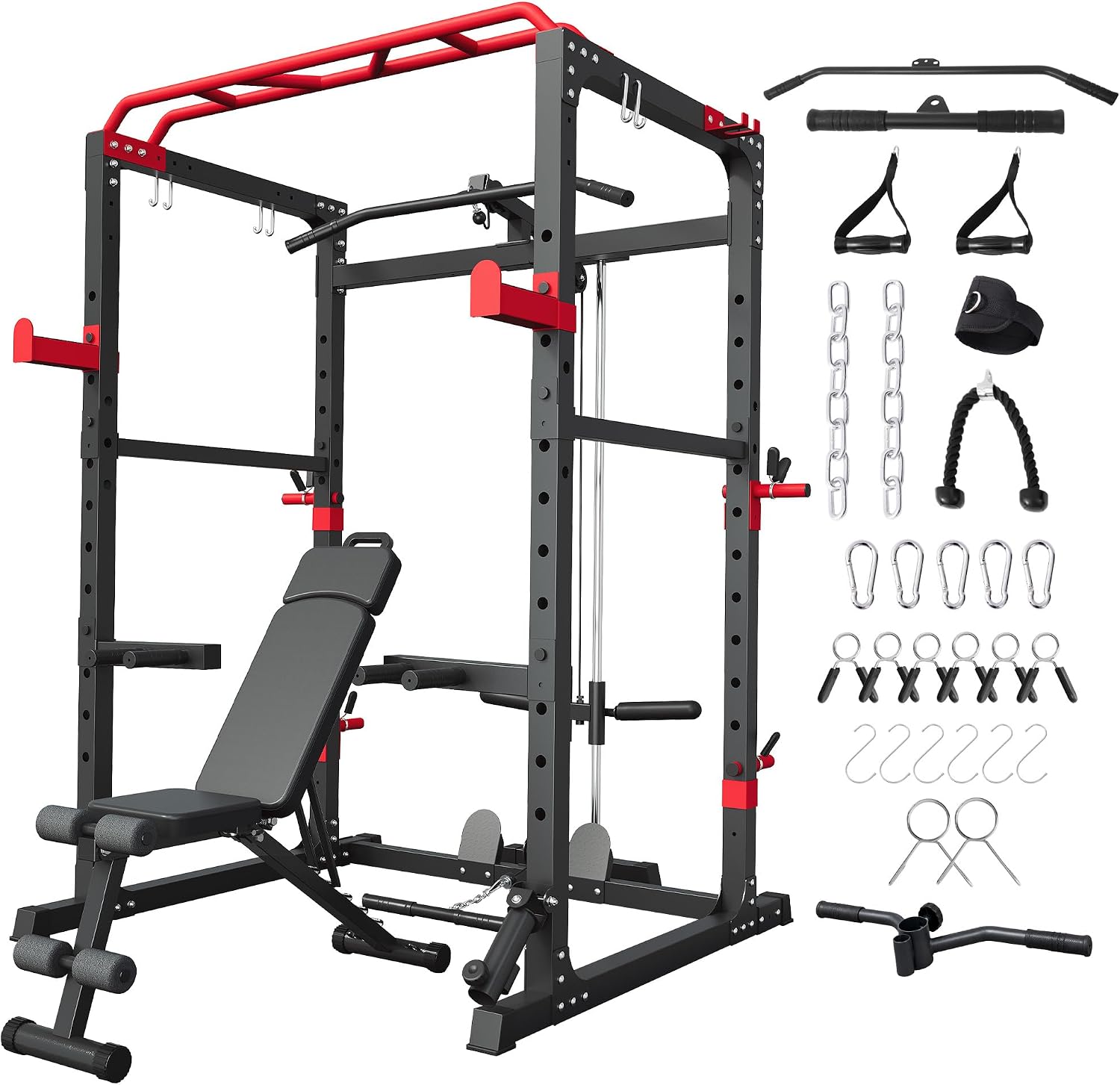 Visit on Amazon → HULKFIT Power Rack with Lat Pulldown |
A first rack on a tighter budget | Bolt hardware and how the pulldown tower ties into the frame | Same name as the rack above, different listing |
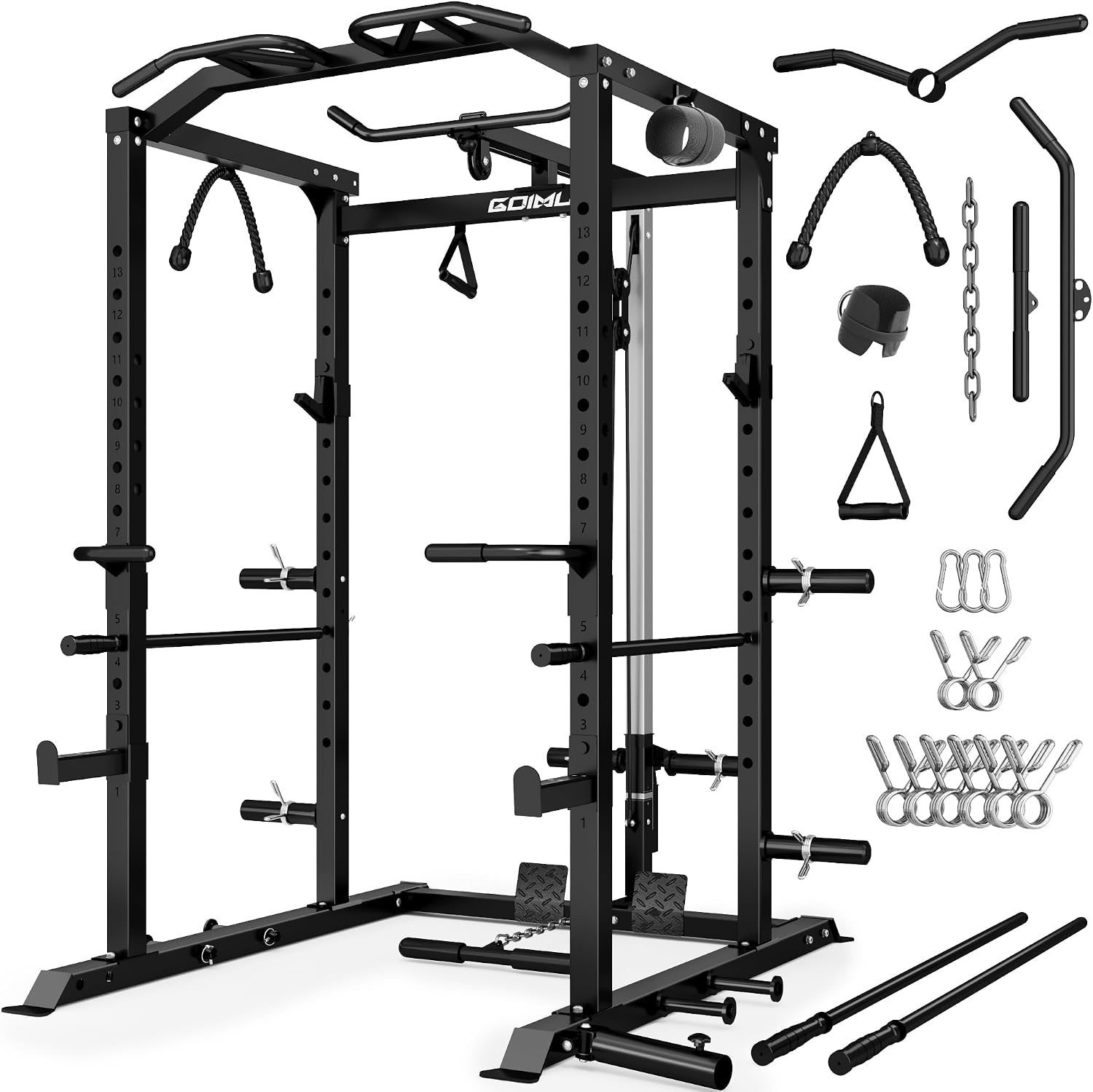 Visit on Amazon → C1-V4 Pro Power Cage |
Lat pulldowns without your body drifting up the seat | Cage depth against your bench length | Leg hold-down is the differentiator |
 Visit on Amazon → YOLEO All in One Weight Bench Set |
Benching inside or in front of any rack here | Pad play and frame rigidity at incline | Advertised as ASTM certified |
How I judge a rack before I load it
Four things decide whether a rack is worth owning, and none of them is the powder coat.
Steel gauge, checked not read. The sticker on the box is marketing. Calipers are truth. Serious racks use 11-gauge tube, roughly 0.12 inches, and anything thinner flexes under real loads. A rack built from 14-gauge tube with a four-digit capacity sticker on it should stay in the box it shipped in.
Weld penetration. This is where the money goes and where budget racks hide their shortcuts. I want a bead that fuses into the base metal at the corner joints, especially the top corners of the uprights, because that is where a failed squat puts its load. A weld that sits on the surface like a bead of caulk will hold right up until the day it matters.
Bolt hardware. Grade-8 bolts, not hardware-store specials. If the bolt bag feels like it came from a big-box bin, replace the hardware before assembly. It is the cheapest upgrade you will ever make to a rack.
The base. Flat-foot racks sit on the floor without bolting, which is what you want in a rental garage, but they give up some stability to a bolted base. If you bolt, bolt into concrete properly, not into a stud you hoped was centered. Wall mounts are great until they are not: miss the stud and you are hanging your face from drywall.
Then the safety gear. J-hooks that tip when you re-rack crooked are a problem, and spotter arms rated below your squat are decoration. I have failed a squat at 495 and I have zero interest in finding out what the floor tastes like.
Where the money actually goes
Rank your spending in this order: rack, bench, bar, plates. The rack takes the most abuse and outlives everything else, so it gets the biggest share of the budget. The bench is second because a bench that folds when you drop 275 on it turns a "1,000 lb capacity" sticker into a lawsuit exhibit.
Between the two HULKFIT racks, the decision is simple. Under 315 lb working weight with no plans to push past it, take the lower-priced listing and spend the savings on plates. Chasing a bigger squat, take the heavier listing, because the cost difference buys you margin you cannot retrofit later.
The C1-V4 Pro cage answers a different question: do you want to pull heavy lat work without your body climbing out of position, and do you have the floor space to give a cage its own zone? If yes, the leg hold-down earns its keep. If your garage is tight, the rack footprint wins.
The YOLEO bench is the sensible pairing for either rack, because a home gym that covers flat, incline, and leg work without three separate machines is a home gym you will actually use on a Tuesday morning before work.
Should you buy the HULKFIT Power Rack with Lat Pulldown?
Yes, if you want one footprint to cover squatting and lat work. The higher-priced listing is the one I would build around, and the lower-priced one is the one I would buy on a first-time budget. Either way, check the welds, swap in grade-8 hardware if the bolt bag looks cheap, and level the uprights before you torque anything down. Do that and you have a rack that will catch a missed rep instead of making the news.
Should you buy the C1-V4 Pro Power Cage?
Yes, if lat pulldowns are a real part of your training and you have the floor space. The leg hold-down is the reason to pick this over a rack, because it keeps your hips down when the weight gets honest. Budget for shims and an afternoon of leveling, and measure your bench against the cage depth before you order.
Should you buy the YOLEO All in One Weight Bench Set?
It is the right call for a one-car garage, where one bench covering flat, incline, and leg work beats three machines you have nowhere to put. Treat the advertised certification as a starting point rather than a finish line, test the pad for side-to-side play, and check the frame at incline. Then bench on it and stop worrying about the number on the sticker.