Related: Best Squat Rack for a Garage Gym: Steel That Holds
Your first home gym squat rack is the only piece of equipment in this hobby that has to outlive everything else you buy. Barbells get sold. Benches get upgraded. Dumbbells get traded for a heavier pair. The rack stays, because it is bolted to your slab and wired into your habits. I have been under a bar for 15 years and I have spent the last six of them loading racks in a garage in Charlotte, reading welds the way other people read spec sheets.
This is a guide to the four pieces that decide whether that garage works: the rack itself, the budget option for a tight space, the dumbbells that handle everything the bar cannot, and the floor underneath all of it. Nothing here is a wish list. Every one of these has a job.
Start with the rack, not the accessories
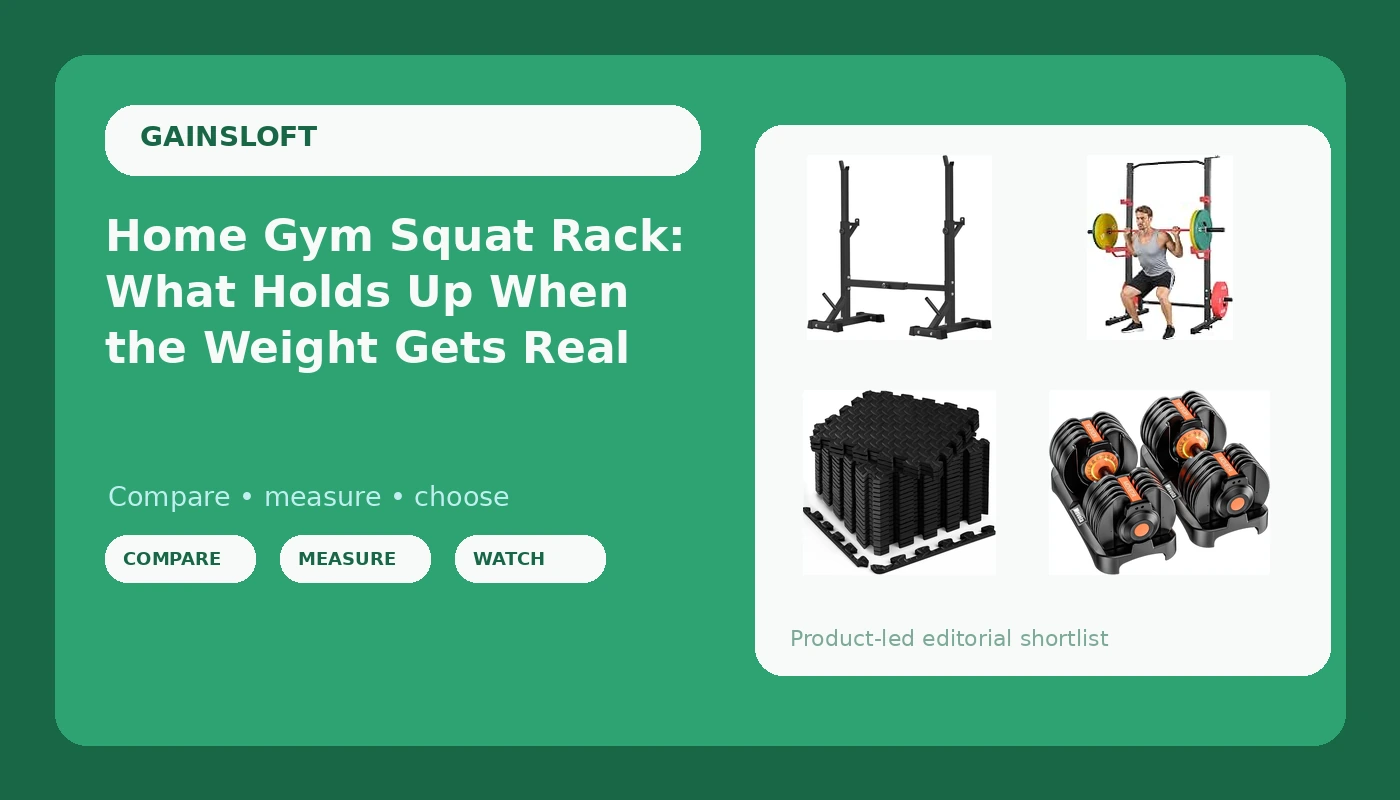
The VEVOR Power Cage Squat Rack is the anchor piece in this group, and it is the one I would build the room around. A cage is a box: four uprights and a frame around the bar. That frame is the point. It is what stands between a missed rep and your neck, and it is why a cage is worth more than two posts and a promise.
The listing will talk about the pull-up station, the bench press capability, and the strength training it supports. Ignore all of it for a minute. What you actually want to know is three things. What gauge is the tube? Where are the welds, and do they penetrate? What hardware holds it together?
Gauge is the first lie in this category. Eleven-gauge steel runs about 0.12 inches thick, and it is the number serious racks are built around. Fourteen-gauge tube with a big capacity sticker is a legal document, not a fact. If you own calipers, put them on the upright. If you do not, grab the frame and shake it. Movement at the upright is movement at the bar.
Weld penetration is the second thing. A pretty bead with no fusion is a lie wearing a tuxedo. The joints that matter are where the uprights meet the crossmembers and where the uprights meet the base plates, because every load path in the rack ends up there. Look for a visible toe line where the weld meets the metal. Look for undercut, porosity, or a bead that stops short of the corner.
Then check the bolts. Grade 8 hardware is what belongs on a rack. If the box ships with soft, unmarked bolts, replace them before you load the bar.
The budget option: BangTong&Li Squat Rack Stand
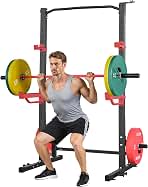
The BangTong&Li Squat Rack Stand is the other kind of rack. It is a stand, not a cage, and it is advertised at 550 lb. A stand is two uprights, a base, and adjustable height, which makes it a good fit for bench press and squat work in a garage where a full cage eats too much floor.
Here is the honest version of that trade. A stand gives you a place to put the bar. A cage gives you a place for the bar to fail. Those are different jobs, and the difference shows up on the rep you cannot finish.
That does not make a stand a bad buy. It makes it a buy with conditions. Know your working weight and be honest about it. If you are squatting 185 and benching 135, a stand rated well above that is a reasonable place to start, and the money you save buys plates. If you are chasing a 405 squat, you want a frame around you and safeties rated above the weight you plan to miss.
Height adjustment is the feature to check first. Every notch has to lock positively, with no slop, because J-hooks that tip when you re-rack crooked are how racks get a bad reputation. Work the locking mechanism by hand before you trust it with a loaded bar. Then check the base plates for anchor holes. A stand that can be bolted down is worth more than one that cannot.
The dumbbells do the work the bar cannot
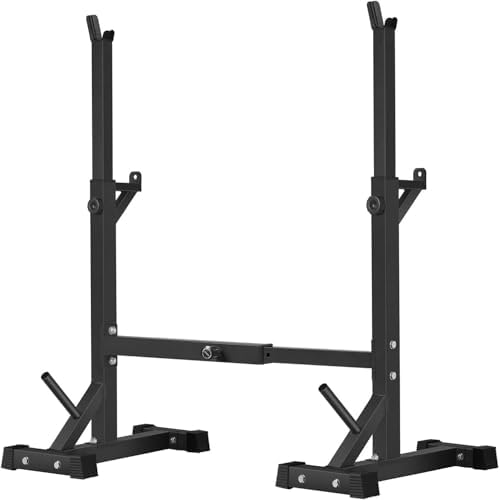
The Adjustable Dumbbells Set of 2 is the piece most people buy last and use most. A barbell is a blunt instrument. It is great at squats, presses, and pulls, and useless for rear delts, single-arm rows, and anything where one side of your body is weaker than the other.
Adjustable dumbbells cover that gap without a rack, a spotter, or a second mortgage. They also change how you train when you are alone, because a failed dumbbell rep is a rep you set down. There is no bar to dump and no pins to catch. For a garage lifter training solo at 6 a.m., that matters more than any number on the box.
The thing to check is the adjustment mechanism. Collars and pins that feel loose when you shake the dumbbell will feel worse under load. Shake them and listen. If you hear a rattle before the first rep, you will hear it on every rep after.
The floor is part of the rack
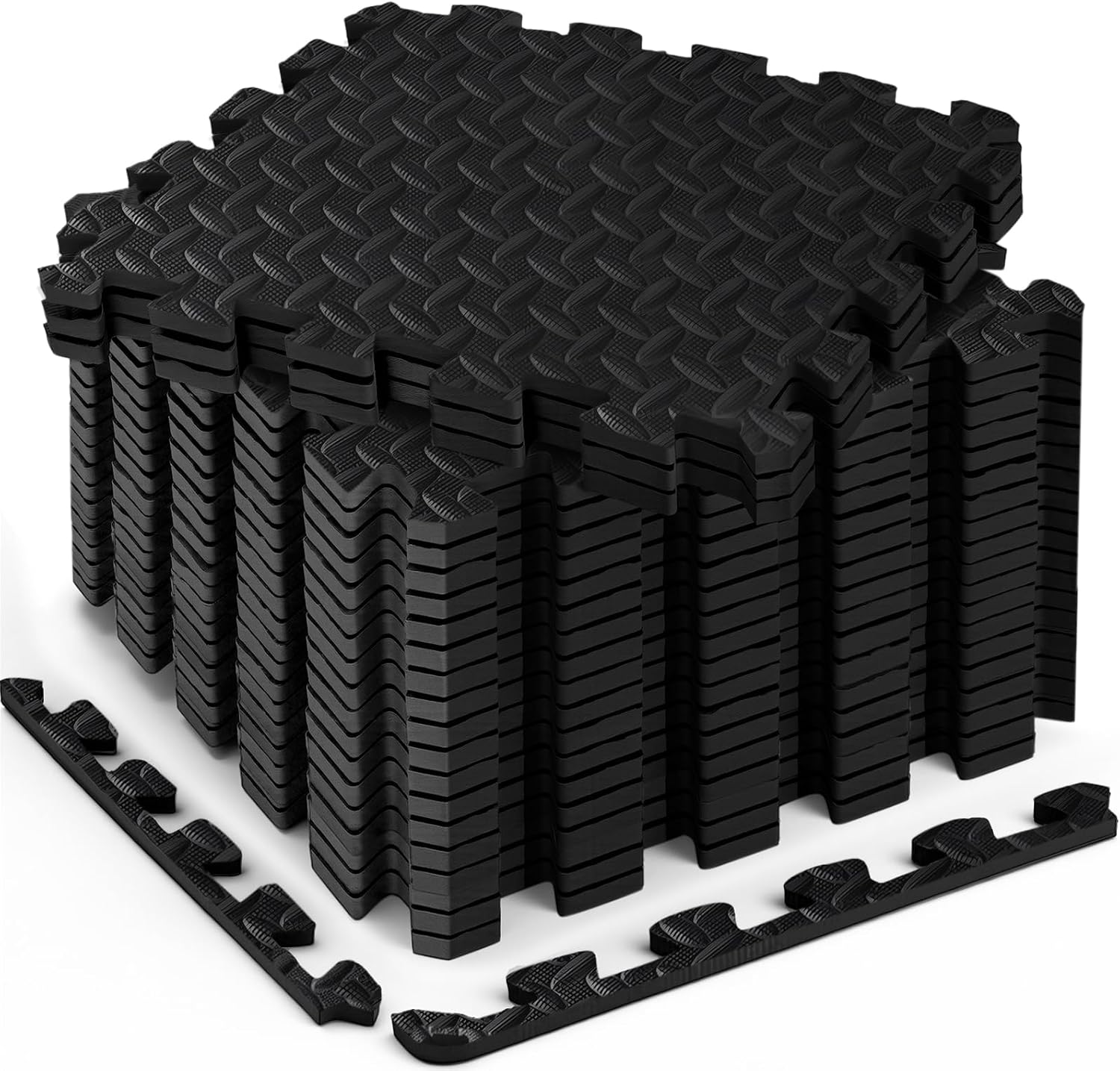
The 18 Pcs EVA Foam Floor Tiles are not glamorous, and they are the cheapest thing in this group by a wide margin. They also solve a problem every garage gym has: a concrete slab that does not care about your equipment or your knees.
Foam tiles do three jobs. They keep iron from chewing up the slab, they give you a surface that does not feel like a parking lot when you sit down to put on your shoes, and they give dropped dumbbells somewhere to land that is not bare concrete. Eighteen pieces cover a decent working area around a rack or a bench, and they lock together without adhesive.
Here is the limit, and it is a real one. Foam compresses. Under a heavy barbell pull, a foam mat is a sponge, and a sponge is not a platform. If you plan to deadlift heavy or do Olympic lifts, you want plywood over the concrete with rubber on top, and the foam goes in the dumbbell area or the warm-up corner. Treat foam as a comfort and protection layer, not as a foundation.
How I check a rack before I trust it
Same sequence every time, whether the rack costs a little or a lot.
First, the steel. Sticker or calipers. If I cannot measure the tube, I shake the frame and watch the uprights.
Second, the welds. Base plates, crossmember joints, and the corners of the base frame. I look for penetration and for any bead that stops short of the toe.
Third, the hardware. Bolt grade, bolt size, and whether the base plates can be anchored. Loose hardware on a rack is a wobble waiting for a heavy day.
Fourth, the loaded stability question. Not "does it hold 1,000 lb" on a sticker, but "what does it do at my working weight." A rack that wobbles at 315 will not get better at 405.
Fifth, the safeties. If the safety arms or pins are rated below the weight you squat, they are decoration. Check that rating against the number you actually put on the bar, not the number you plan to put on it someday.
Analysis: what the capacity sticker does not tell you
Every rack in this category has a number on the box. That number is the least useful data point in the purchase, because capacity is a claim about a moment, and racks fail over a life.
What fails is rarely the tube. It is the connection. A weld with no penetration fails at the toe. A soft bolt stretches. A base plate that was never anchored walks across the floor one heavy set at a time. That is why a cheap rack bolted to the slab is not automatically safer than a more expensive rack that does not need anchors: the bolted rack is only as good as the concrete under it, and the flat-foot rack is only as good as its own weight and geometry.
Flat-foot designs are the right answer for a rental garage where you cannot drill. They give up a little stability to a bolted base, and that trade is fine as long as you know you are making it.
Then there is the question nobody asks until the first failed rep: what happens when the bar comes down and you are not ready. The answer has to be physical, not theoretical. Safeties at the right height, rated above your working weight, set so the bar lands on them and not on you. That is the whole job.
The reference table
| Gear | Job in the gym | What to check | Price |
|---|---|---|---|
 Visit on Amazon → Visit on Amazon →VEVOR Power Cage Squat Rack |
Full frame for squats, bench press, and pull-ups | Tube gauge, weld penetration at the base plates, bolt grade, anchor holes | $159.90 |
 Visit on Amazon → Visit on Amazon →BangTong&Li Squat Rack Stand |
Stand for squat and bench press work in a tight space | Height notch lockup, J-hook behavior, advertised capacity versus your real working weight | $149.99 |
 Visit on Amazon → Visit on Amazon →Adjustable Dumbbells Set of 2 |
Accessory and unilateral work the barbell cannot cover | Adjustment collar and pin slop, rattle under load | $259.99 |
 Visit on Amazon → Visit on Amazon →18 Pcs EVA Foam Floor Tiles |
Slab protection and a landing zone for dumbbells | Compression under a loaded barbell, tile lockup, coverage around your rack | $22.49 |
Should you buy the VEVOR Power Cage?
Yes, if you have the floor space and you train alone. A cage is the only design in this range that gives you a frame around the bar plus a pull-up station without asking your ceiling for permission. Buy it if you squat and bench heavy without a training partner, because the frame is the whole reason the cage exists.
Skip it if the garage is tight or the budget still has to cover a bar and plates. A cage that leaves you no room to load the bar is a cage you will stop using.
Should you buy the BangTong&Li Squat Rack Stand?
Yes, if you are honest about your working weight and you need a stand that fits a small footprint. It handles squat and bench press work, the height adjusts, and it costs less than a cage by enough to matter when you are buying plates in the same month.
Be clear about what it is. There is no box around you. If you are training solo and pushing close to your limit, the rack that catches you is worth the extra money.
What about the dumbbells and the floor tiles?
Buy the adjustable dumbbells before you buy a second barbell. They cover the accessory work a bar cannot, they need no spotter, and they are the difference between a program and a pile of lifts. Put the foam tiles on the same order, because protecting the slab and your knees costs less than any other upgrade in the room.
And then bolt the rack down. I put that off for a year. Do not be me.