Most people shopping for a home gym squat rack start with the wrong question. They ask which one is strongest, or which one carries the biggest capacity sticker, and they skip the two things that actually decide the purchase: how much room you have, and how much weight will be on the bar three years from now. I spent four years as a welder's apprentice before I moved into industrial maintenance, and I have been under a bar for fifteen years. The racks that scare me are rarely the ones that lost a spec sheet argument. They are the ones bolted to a wall that could not carry the load, or the ones the owner outgrew in eight months and then kept loading anyway. This is an explainer on four squat rack designs for a home gym: what each one is built to do, what it gives up, and how to tell whether it belongs in your garage before it shows up at your door.
Related: Squat Rack Tube Gauge: What 11-Gauge Steel Actually Means →
Quick answer
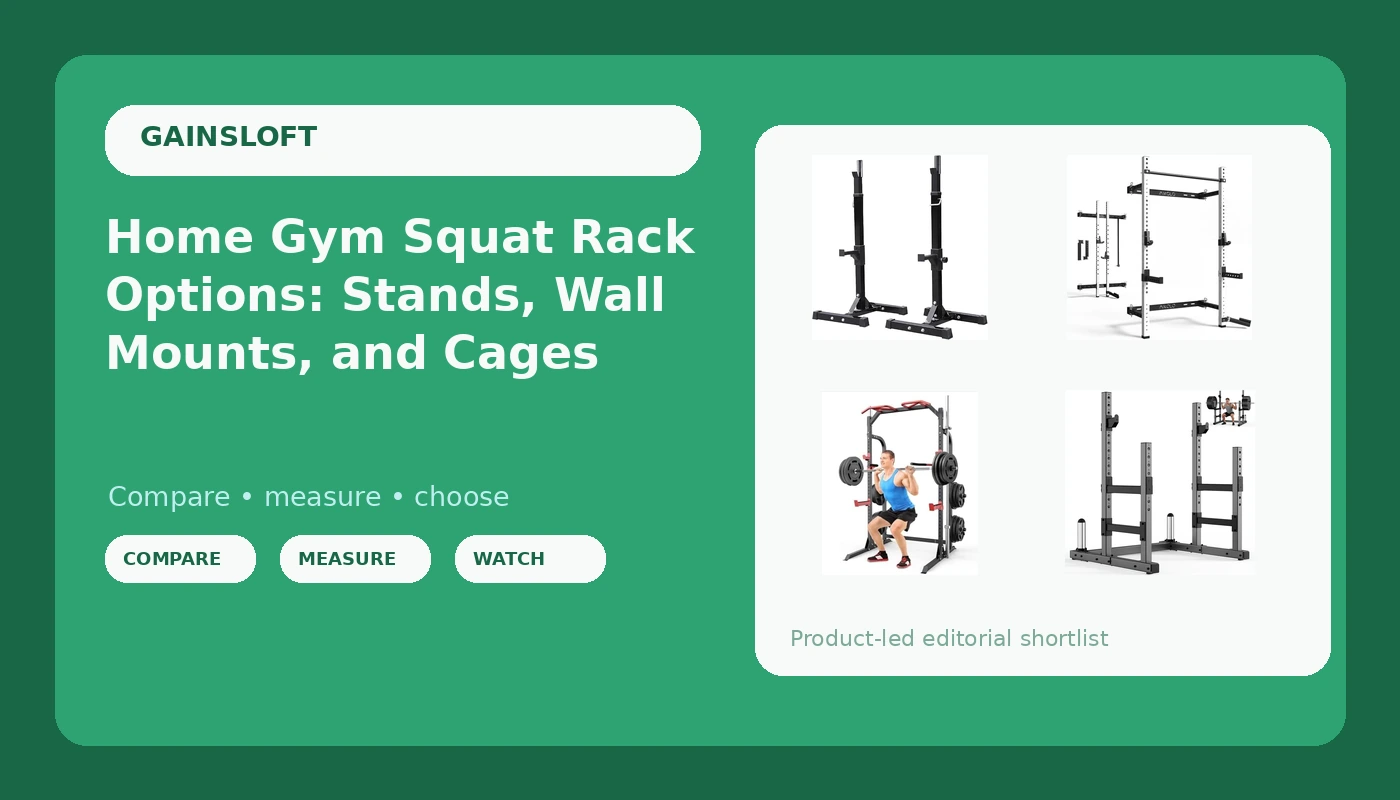
Match the rack design to your room and your anchoring situation first, then size the steel to the weight you will actually handle. A pair of adjustable squat stands such as the Yaheetech set is the simplest way to get a bar in the air, and it leans on the floor and the bar for stability rather than on an enclosure. An adjustable rack like the PASYOU fits rooms and lifters that a fixed rack does not. A folding wall mounted rack like the Mikolo protects your floor space, but the wall becomes part of the load path. A full power cage like the SunHome gives you the most training options and takes up the most room. None of these four is automatically the right answer for you, and none of them should be bought without checking the hardware, the mounting surface, and the tube size in the listing.
Four useful options
| Model | Best fit | What stands out |
|---|---|---|
| Yaheetech Adjustable Squat Rack Pair, Barbell Bench Press Stands, Home Gym | Lifting in a shared or temporary space | Adjustable stands sold as a pair, for squat and bench press |
| PASYOU Adjustable Squat Power Rack for Home Gym | Rooms and lifters that need an adjustable frame | Adjustable power rack design rather than a fixed width |
| Mikolo 2" x 2" Folding Wall Mounted Squat Rack | Garages where the car still has to park inside | Folds to the wall, with pull up bar, J hooks, and other attachments |
| SunHome Power Cage Squat Rack | A dedicated training corner with room to spare | Pulley system, adjustable cable crossover, J hooks, dip handles, plate storage |
The starter pair: Yaheetech Adjustable Squat Rack Pair, Barbell Bench Press Stands, Home Gym
This is the category that makes sense when the room is temporary, the ceiling is low, or the budget is the hard constraint. You get a bar at the right height, and you get to bench press without asking a friend to hand you the bar. What you give up is everything a cage does: there are no integrated safeties catching a missed rep, and the whole assembly depends on a flat, solid floor and on you not drifting sideways with the bar. If you go this route, treat your working weight honestly, set the stands wide enough to be stable, and use a spotter or a set of separate safety stands on anything close to a limit attempt. It is also worth checking the listing for the tube size and the hook design, because a stand pair lives or dies by how its base sits and how the hooks hold the bar.
The adjustable middle: PASYOU Adjustable Squat Power Rack for Home Gym
Adjustability is a convenience feature, and convenience always costs something. Here it costs you a handful of extra joints: every place the frame adjusts is a place that can loosen, shift, or wobble if it is not set and tightened properly. That is not a reason to avoid it, it is a reason to treat assembly like part of the training plan. Set the rack where you want it, torque everything down, then re-check every pin and bolt after your first few sessions, because that is when things settle. The payoff is real for anyone sharing a garage with a car, a motorcycle, or a spouse's storage, or for anyone whose ceiling or wall layout rules out a fixed rack. If you are between sizes, this is the category that lets you stop guessing.
The space saver: Mikolo 2" x 2" Folding Wall Mounted Squat Rack
A wall mounted rack is the best space trade in the category and the worst place to guess. The capacity number on the listing is only as good as the structure behind the rack: a 1,000 pound rating does not mean much if the uprights are lagged into one stud and drywall. Before you order, find your studs with a stud finder and confirm the spacing, because if your wall is framed on 24 inch centers instead of 16, the mounting plan changes. Plan to span studs with a proper ledger or mounting board rather than trusting two lonely fasteners, use the anchor type the manufacturer specifies for your wall material, and if you cannot hit solid framing, stop and pick a different design. Do that work and this is a rack that disappears when you are not training, which is exactly what a garage gym needs.
The full cage: SunHome Power Cage Squat Rack
This is what most people picture when they say home gym squat rack, and it is the design that gives you the most training for the floor space it eats. Squat and bench inside the cage, cable work on the crossover, dips on the handles, plates on the storage pins. The trade-offs are space and setup time: measure the ceiling before anything, because a pull up bar and an overhead press both need clearance, and count the number of parts you are going to assemble on a Saturday. Cable systems also add moving pieces that deserve a look during assembly, since a pulley that runs rough or a crossover that binds is easier to fix before the rack is loaded and bolted than after. If you have a dedicated corner and you want one machine to cover several jobs, this is the category that pays you back.
Prices and availability may change. Product images, names, and retailer links must be matched by verified ASIN. Do not state a current price, rating, stock status, or measured result without current evidence.
What the capacity sticker does and does not tell you
A capacity number on a listing is a claim, not a measurement. The number that backs it up lives in three places you can actually check: the tube gauge, the weld quality, and the hardware. Tube gauge is the thickness of the upright steel, and thinner tube flexes earlier under the same load, which is why two racks with the same sticker can behave nothing alike. Welds are where the load travels from one piece of steel into another, so look at how the joints are finished and whether they look fused into the metal or laid on top of it like frosting. Hardware is the least glamorous and most common failure point: grade 8 bolts, thick J hooks, and pins that fit their holes without slop all matter more than the powder coat. When a listing gives you a capacity figure and nothing else, treat the figure as the manufacturer's claim and go looking for the gauge, the joints, and the fasteners before you decide.
Measure the room before you buy the rack
Every rack decision starts with a tape measure, not a spec sheet. Ceiling height decides whether you can do pull ups and overhead work inside the rack. Floor type decides whether you can anchor at all, since concrete takes wedge anchors and a wood subfloor over joists is a different conversation entirely. Bar length decides whether a rack is wide enough that you can load plates without hitting the uprights. Wall construction decides whether a folding wall mount is even an option in your garage. And your own height decides where the J hooks and safeties need to sit for a squat, a bench press, and a failed rep. Do this measuring before you fall in love with a rack, because a rack that does not fit the room becomes a rack you resell at a loss.
Here is the order I would work through it:
- Measure ceiling height, wall length, and available depth, then write the numbers down.
- Identify your floor and wall construction so you know what anchoring is possible.
- Decide whether you need cable and dip capability now, or whether you can add it later.
- Inspect the hardware spec: bolt grade, J hook thickness, pin diameter, and tube gauge.
- Size the rack to the weight you expect to handle in three years, not the weight you handle today.
Setting the rack up so it holds
- Anchor into concrete with the correct wedge anchors if you can, and span studs with a ledger board when you mount to a wall.
- Re-check every bolt, pin, and adjustment point after your first few sessions, then again after a month.
- Set your J hooks and safety bars to the height where a failed rep actually lands on the safeties, not the height that looks tidy.
- Put rubber or stall mats under the rack and the bar, and keep the floor flat so the base sits evenly.
- Load test the setup gradually with your normal working sets before you take anything close to a limit single.
Which option should you choose?
Choose the Yaheetech Adjustable Squat Rack Pair when you need a bar at the right height in a shared, temporary, or low-ceiling space and you can train with a spotter or separate safeties. Choose the PASYOU Adjustable Squat Power Rack when your room or your lifting position needs a frame that adjusts rather than a fixed footprint. Choose the Mikolo Folding Wall Mounted Squat Rack when floor space is the binding constraint and you can confirm solid framing behind the wall. Choose the SunHome Power Cage Squat Rack when you have a dedicated corner and you want squat, bench, cable, and dip work from one station.
One caveat worth stating plainly: this article describes what each listing offers, not a laboratory result. Capacity figures, tube sizes, and included attachments come from the product listings and should be confirmed there before you buy, because manufacturers revise hardware and specs without notice. Nothing here has been declared the strongest, safest, or quietest of the group, and any claim that specific would need measured evidence that a listing alone cannot provide.
The bottom line
The rack is the one piece of equipment that has to outlive everything else you own, so buy the design that fits your room and the steel that fits your three-year working weight. If space is tight and framing is solid, a folding wall mount like the Mikolo earns its place. If your room changes or your setup is temporary, an adjustable rack like the PASYOU gives you room to move. If you have a dedicated corner, the SunHome cage covers the most jobs. And if you just need a bar at the right height today, the Yaheetech stands will do that job as long as you respect what they are not. Check the gauge, check the welds, check the bolts, then bolt it down and get under it.