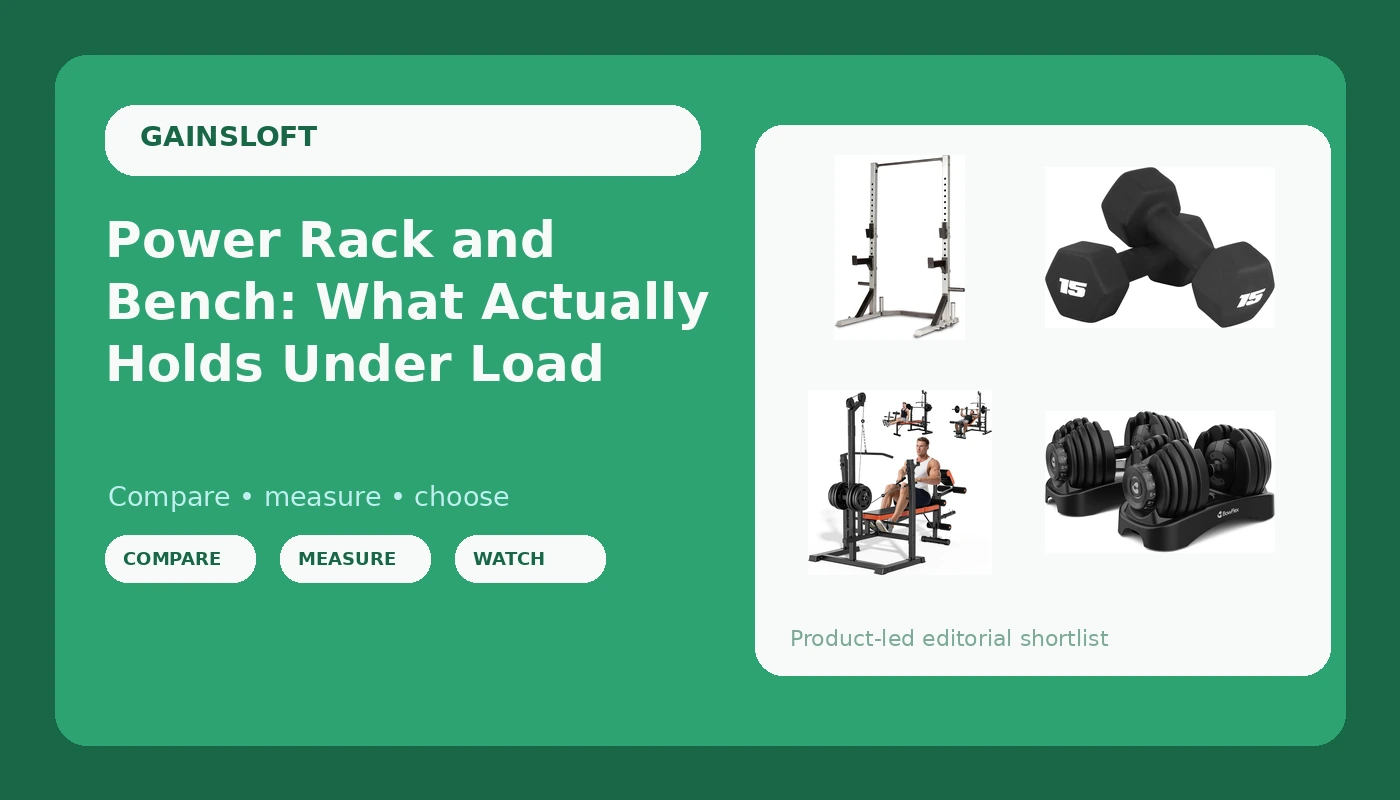
Most garage gyms get built backwards. The bar comes first, then the plates, then a bench that folds flat into a closet, and only at the end does anyone look hard at the squat rack, which is the one piece that has to catch a failed rep. If you are shopping for a home gym squat rack and bench at the same time, the order you buy in matters less than the standard you hold each piece to. The rack is the only item in the room that has to outlive everything else you own, and the bench is the second most dangerous thing in the room after it.
Related: How Much Steel Do You Actually Need in a Power Rack? →
Quick answer
Buy the rack for the weight you expect to squat in two years, not the weight on the bar this week, and verify the tube gauge before you trust the capacity sticker. Pair it with a bench whose pad does not rock side to side at incline, since that is where benches actually fail. Treat dumbbells as the accessory layer: adjustable if floor space is tight, fixed pairs if you want small increments for press progression.
Four useful options
| Model | Best fit | What stands out |
|---|---|---|
| CAP Barbell FM-8000F Deluxe Power Rack Color Series | A full cage as the center of a garage gym | Full-cage power rack format from the CAP Barbell Color Series line |
| XDDIAS 9-in-1 Olympic Weight Bench Set with Lat Pulldown, Rowing, Squat Rack, Leg Extension/Curl, Preacher Pad, 900LB Adjustable Bench Press | One footprint that covers benching, leg work, and lat work | Multi-function bench set the listing describes as nine stations in one frame |
| BowFlex Results Series SelectTech Dumbbells | Replacing a rack of fixed pairs in a small space | Adjustable dumbbell design from the SelectTech line |
| CAP Barbell Neoprene Dumbbell Weights Pairs & Sets | Warm-ups, shoulder work, and high-rep accessories | Neoprene coated dumbbells sold as pairs and sets |
The rack: CAP Barbell FM-8000F Deluxe Power Rack Color Series
A full cage is the right starting point for most garage gyms because it gives you three things at once: a place to squat, a place to bench with safeties set, and a frame to hang plates and attachments from. The Color Series naming is cosmetic, so do not let the finish be the deciding factor. What you want to look at is the steel and the joints.
Put your eyes on the inside corner where each upright meets the base and where the crossmembers tie in. A weld that sits on top of the joint like a bead of caulk is holding the surface of the metal, not the metal itself. A weld with a visible toe line biting into both pieces is penetration, and penetration is what keeps a missed rep off your neck. Then check the hardware: grade-8 bolts with real washers, not hardware store stock. Finally, decide about anchoring. A bolt-together cage on a concrete floor that is anchored at the base behaves differently from one that is free standing, and if you are renting, that decision belongs to your landlord, not your ego.
The multi-station bench: XDDIAS 9-in-1 Olympic Weight Bench Set
Multi-station frames exist because most people have one floor space, not four. The trade is straightforward: a dedicated rack and a dedicated bench each do one job with fewer moving parts, while a combo frame does several jobs with more pins, more hinges, and more places for play to develop. That does not make the combo a bad buy. It makes it a buy you have to inspect differently.
Sit on the bench pad at flat, then at incline, and try to rock it side to side with your hand. If the pad moves under hand pressure, it will move under a loaded bar. Check the pin and ladder mechanism that sets the incline angle: it should seat with a positive click and no slop in the slot. Read the capacity figure on any adjustable bench as a claim from the listing rather than a measured fact, then look at the hinge plates and the welds around them to judge whether the claim is plausible. On a frame this complex, assembly torque is not a one-time job. Re-check every bolt after the first few weeks.
The adjustable dumbbell: BowFlex Results Series SelectTech Dumbbells
Dumbbells are where a home gym either stays flexible or turns into a museum of mismatched pairs. The argument for adjustable is floor space and cost per pound; the argument against is that a selector mechanism is a mechanism, and mechanisms do not like being dropped. If you train dumbbell presses to failure and let the last rep go, adjustable dumbbells are the wrong tool, because the failure you are training for is the failure they are least built for. If you set them down under control, they cover a very wide range of movements in a footprint that fits beside a car.
The other half of the decision is increments. Adjustable pairs move in larger steps than a rack of small fixed dumbbells, which matters for press progression where a five pound jump is a big jump. For most accessory work, that is fine. For a strict overhead press cycle, it is a real limitation worth knowing before you buy.
The light dumbbell layer: CAP Barbell Neoprene Dumbbell Weights Pairs & Sets
The small dumbbells are the ones people skip and then wish they had. Rotator cuff work, rear delt raises, warm-up sets for a shoulder that has been complaining since 2019, and the high rep finishers that keep a pressing program from stalling. A pair of light neoprene dumbbells next to the rack gets used more often than a set of heavy pairs in a corner, because the work they support is short, frequent, and easy to skip.
The coating matters more than it sounds. Neoprene is quieter on a concrete floor and kinder to a wood platform than bare metal hex heads, and it does not chew up a bench pad when you set them down. Buy them as a pair or a set so you have a step up and a step down available, and keep them where you can reach them without walking across the garage.
Prices and availability may change. Product images, names, and retailer links are matched to verified listings. No current price, rating, stock status, or measured result is stated here without current evidence.
Steel gauge, welds, and what a capacity sticker means
Tube gauge is the first number that matters on any rack. Racks are sold in 11-gauge, 12-gauge, and 14-gauge tube, and the difference is not cosmetic. Eleven gauge steel runs roughly 0.12 inches thick, and thinner tube flexes under load in a way you can feel through the bar. A rack that moves at 315 will move more at 405. Failure is rarely a dramatic snap. It is a slow walk of the uprights that shows up as a wobble you learn to ignore, which is exactly the wrong response.
Welds are the second thing. A bead can look like a stack of dimes and still have no penetration, which means the joint is held by the surface of the metal rather than the metal itself. Look at the inside corners where uprights meet the base and where crossmembers tie in. Then look at the parts that touch you: j-hooks that tip when you re-rack crooked, and spotter arms rated below the weight you squat, which makes them decoration rather than safety equipment.
The capacity sticker is a claim, not a measurement. When you see a four figure number on thin tube, you are reading a legal document. The gauge, the weld penetration, and the hardware grade are the evidence, and they are what you are actually buying when you hand over money for steel.
Where benches and dumbbells actually fail
Benches do not usually fail at the frame. They fail at the pad and the ladder. The failure mode is side to side rock at incline, where the angle of the back pad transfers load through the hinge. Test it unloaded: sit at flat, then set the incline and try to rock the pad left and right with your hands. If it moves for you, it will move for a loaded bar. Pad width matters too, because a pad too narrow leaves your shoulder blades hanging off the edge, and a pad too high off the floor takes your feet out of contact and kills leg drive.
Dumbbells fail by rep range, not by construction. Fixed pairs in small increments are right when you are running linear progression on presses and need a five pound step. Adjustable pairs are right when floor space is the binding constraint and you set the weights down under control. Neither one is wrong, but buying the wrong one for your training style is how a corner of the garage fills up with equipment you stop touching.
- Write down the weight you intend to squat and bench two years from now, and buy the rack for that number.
- Measure the space honestly, including ceiling height for a lat pulldown and clearance behind the bench for a spotter.
- Check tube gauge and weld penetration on any rack before you read the capacity sticker.
- Sit on the bench unloaded at flat and at incline and try to rock the pad side to side.
- Decide how much floor space dumbbells can take before you commit to fixed pairs or adjustable.
Setting up the space around the equipment
- Anchor the rack or weigh the base down, and if you anchor, confirm what is under the concrete before you drill.
- Set safety bars just below your bottom position so a failed rep lands on steel rather than on you.
- Leave enough room behind the bench that a training partner can stand there, because solo benching with safeties is a skill you have to practice.
- Keep dumbbells on a rack or the floor, never on a bench pad, since a pad that takes a dropped dumbbell is a pad you stop trusting.
- Re-check hardware torque after the first month, and again after the first heavy cycle, because new joints settle.
Which option should you choose?
Choose the CAP Barbell FM-8000F Deluxe Power Rack Color Series when the cage is the center of the room and you want to squat and bench inside a full frame. Choose the XDDIAS 9-in-1 Olympic Weight Bench Set when you have one footprint to spend and want benching, leg work, lat work, and preacher curls in a single frame. Choose the BowFlex Results Series SelectTech Dumbbells when floor space is the constraint and one adjustable pair needs to stand in for a rack of fixed dumbbells. Choose the CAP Barbell Neoprene Dumbbell Weights Pairs & Sets when you need the small end of the range for warm-ups, shoulder work, and high rep accessories.
No measured stability result is reported here for any of these products, and capacity figures are quoted as they appear in the listings rather than as tested numbers. Verify gauge, hardware, and pad behavior yourself before you load anything heavy on it.
The bottom line
Build the room around the rack, because it is the piece that has to catch you. Check the steel and the welds before you check the paint, buy for the lifter you plan to be rather than the one you are today, and set the safeties before the first heavy set. Add the bench that does not rock at incline, then add dumbbells that match your rep ranges rather than your ambitions. A garage gym that holds up is not the one with the most equipment. It is the one where every piece was chosen for a job you actually do.