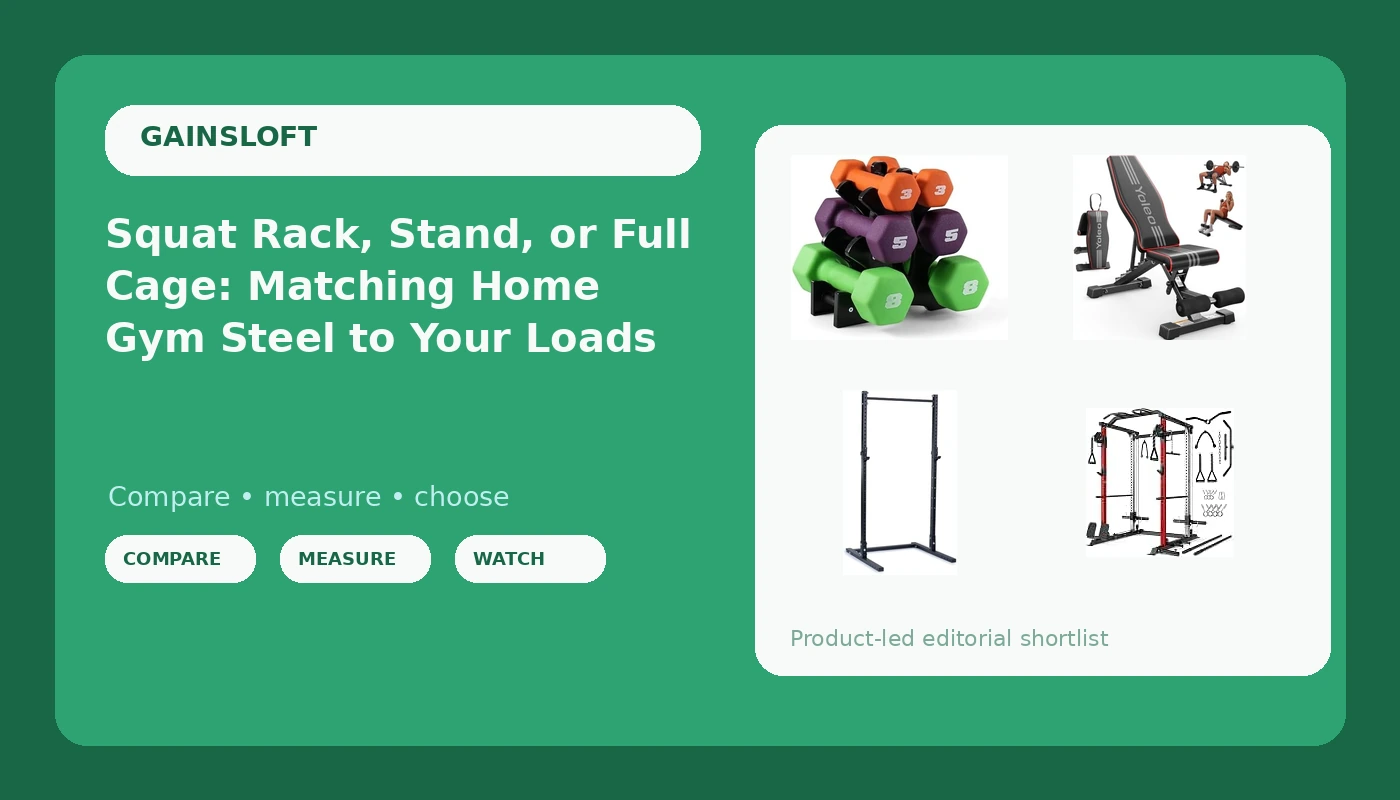
A home gym squat rack is the purchase every other piece of equipment has to answer to. Get the footprint wrong and your bench will not fit inside the uprights. Get the hole spacing wrong and your J-hooks sit an inch off the height you actually press from. Get the frame wrong and you find out during the one rep you cannot finish. This guide covers four pieces that handle the main jobs in a garage or spare bedroom: a full cage with a cable system, a tall squat stand, an adjustable bench, and a set of dumbbells for everything that does not need a bar. It explains what the listed capacity numbers do and do not mean, where the real trade-offs sit, and which combination fits which kind of lifter.
Related: How to Anchor a Squat Rack to a Garage Floor →
Quick answer
If you want one frame that covers squats, presses, and cable work, the DP01 Power Cage is the most complete option here, with a manufacturer-listed 2000 lb capacity, a dual independent pulley system, and a cable crossover. If floor space or ceiling height is tight and you already own a bar and plates, the Titan Fitness T-3 Series 92.5" Squat Stand is the smaller-footprint choice, with a listed 1,000 lb capacity, Westside hole spacing, a pull-up bar, and J-hooks. Add the YOLEO Adjustable Weight Bench for flat and incline pressing, and the CAP Barbell neoprene dumbbells for accessory work. Every capacity figure below is a manufacturer listing, not an independent test result, so match it against the loads you genuinely handle.
Four useful options
| Model | Best fit | What stands out |
|---|---|---|
| DP01 Power Cage, 2000LBS Squat Rack with Cable Crossover and Dual Independent Pulley System | Full-body training from one frame | Full cage plus cable crossover and dual independent pulleys; listed 2000 lb capacity |
| Titan Fitness T-3 Series 92.5" Squat Stand, 1,000 LB Capacity | Tight footprints and lower ceilings | Listed 1,000 lb capacity, Westside hole spacing, pull-up bar and J-hooks included |
| YOLEO Adjustable Weight Bench, ASTM-Certified 827LBS | Flat, incline, and decline pressing | ASTM certification referenced in the listing; listed 827 lb capacity |
| CAP Barbell Neoprene Dumbbell Weights Pairs & Sets, Color Series | Warm-ups, accessories, unilateral work | Neoprene coating; sold in pairs and sets; color series for quick weight ID |
The full cage: DP01 Power Cage
The trade-off with a full cage is room, not strength. Four uprights and a base footprint need floor area a squat stand does not, and the cable crossover adds width on top of that. Measure ceiling height against the upright height before you order, because a cage that clears by two inches is a cage you cannot use for a standing press. The pulley system is also a moving assembly: cables, pulleys, and a weight carriage need periodic inspection and lubrication the way any cable machine does. What you get for that is a frame that does squat, bench, press, and cable work without a second purchase, which is why it is the anchor of this group.
The space-saving upright: Titan Fitness T-3 Series 92.5" Squat Stand
A squat stand trades bracing for floor space. There is no second pair of uprights behind you, so the safety you get from a full cage has to be replaced by spotter arms or by training inside a setup you trust. Westside hole spacing matters here for a practical reason: tighter holes through the bench and press zone mean your J-hooks and safeties land where your body actually puts the bar, instead of an inch high or low. At 92.5 inches the stand is tall enough for most standing work but tall enough to be a ceiling problem in a basement, so verify clearance first. If you lift alone and train near your limit, this is the option where you should think hardest about how a failed rep gets caught.
The adjustable bench: YOLEO Adjustable Weight Bench, ASTM-Certified 827LBS
Every adjustable bench has a hinge, and the hinge is where an adjustable design differs from a flat bench. Check two things before you buy: the gap between the back pad and the seat pad when the bench is flat, and whether the bench is narrow enough to sit inside your rack's uprights. A bench that is an inch too wide will not let you set up inside the cage, which turns a good rack into a spotter-required rack. ASTM certification referenced in the listing is a useful signal about how the bench was evaluated, but it is not the same as knowing the bench holds your specific working weight at an incline, so treat the listed capacity as a ceiling rather than a target.
The dumbbells: CAP Barbell Neoprene Dumbbell Weights Pairs & Sets, Color Series
Fixed dumbbells are a different purchase than a rack. You are not buying a frame that outlives everything else, you are buying increments you will eventually outgrow on some movements and never outgrow on others. That makes set composition the decision: a pair covers one weight, a set covers a range, and a range is usually what accessory work needs. Neoprene is a practical coating for a garage or a spare room because it does not chip concrete the way bare iron can, but neoprene also takes up more space per pound than a hex head, which matters if you are storing a full run of weights. Buy these for the work around the barbell, not as a replacement for it.
Prices and availability may change. Product images, names, and retailer links must be matched by verified ASIN. Do not state a current price, rating, stock status, or measured result without current evidence.
What a capacity rating actually tells you
A capacity number is a manufacturer claim, and the useful question is what the claim rests on. Steel gauge is the first check. Serious racks are typically built from 11-gauge steel, roughly 0.12 inches of wall thickness, while lighter frames use thinner tube. A thin tube with a big number on the sticker is a marketing document, not a structural one. The second check is the weld. A clean bead with shallow penetration is cosmetic; what you want is fusion into the base metal at the corners where the uprights meet the base.
The third check is how the rack meets the floor. A bolted base resists tipping and walking. A flat-foot design relies on the geometry of its feet and on the weight of the frame and plates, which is fine in a rental garage where you cannot drill, and less fine if you train alone near your limit. The fourth check is hardware. Grade-8 bolts in the joints are a different animal from generic hardware store bolts, and on a bolt-together rack the bolts are part of the structure.
The fifth check is safety hardware. Spotter arms and safety bars are rated separately from the frame in most listings. If the safeties are rated below the weight you squat, the number on the rack does not matter, because the safeties are what catch you. Check the safety rating, then check the rack rating.
Matching the rack to the bench, the bar, and the room
- Measure ceiling height at the lowest point, not the average. A duct, a light fixture, or a garage door track decides your maximum upright height.
- Measure floor area including the bar. A seven-foot bar plus plates needs clearance beyond the rack footprint, and a cable crossover adds width on top of that.
- Confirm the bench fits inside the uprights. Interior width and pad width decide whether you can press inside the cage or have to pull the bench out.
- Match the safeties to your working weight, not your one-rep max. Safeties set just below your bottom position catch a failed rep without forcing you into a bad position.
- Decide the floor question before ordering. Bolting is the strongest option, flat-foot is the flexible option, and you should pick based on whether you can drill into the slab.
- Check tube gauge against the capacity sticker rather than trusting the sticker alone.
- Inspect welds at the upright-to-base joints on arrival and photograph anything that looks like a cold lap or a gap.
- Re-torque every bolt after the first week of use, then check them monthly.
- Set J-hooks and safeties at the same height on both sides, and mark the holes you use so you stop counting.
- Keep cable systems clean and inspected if you buy a cage with pulleys, because a frayed cable is a failure point.
- Leave the rack unbolted only if the design is meant for it, and never bolt a light rack to the floor as a substitute for buying a heavier one.
Which option should you choose?
Choose the DP01 Power Cage when you want one frame that covers barbell training and cable work, you have the floor space for a full cage, and the ceiling clears its height. Choose the Titan Fitness T-3 Series 92.5" Squat Stand when space or ceiling height is the constraint, you already own a bar and plates, and you have a plan for catching a failed rep. Choose the YOLEO Adjustable Weight Bench when you need flat and incline pressing from a single bench and you have confirmed it fits inside your rack. Add the CAP Barbell Neoprene Dumbbell Weights Pairs & Sets when the barbell is handled and what is missing is the accessory layer.
The limits here are the limits of the listings. Capacity figures come from the manufacturers, not from independent load testing, and no spec sheet tells you how a specific rack behaves at your specific working weight. If you train alone and heavy, the safety hardware matters more than any capacity number, and the honest answer is that the only way to know how a rack behaves under load is to load it.
The bottom line
Build the room around the frame first. A full cage like the DP01 Power Cage gives you the widest range of training in one footprint and adds cable work on top of the barbell basics. A tall squat stand like the Titan Fitness T-3 Series covers the same barbell movements in less floor area, provided you solve the safety question. The YOLEO Adjustable Weight Bench handles the pressing angles, and the CAP Barbell neoprene dumbbells fill in the accessory work. Read the capacity numbers as manufacturer claims, check the steel, the welds, the hardware, and the safety rating in that order, and buy the frame you will still be using when everything else in the garage has been replaced.