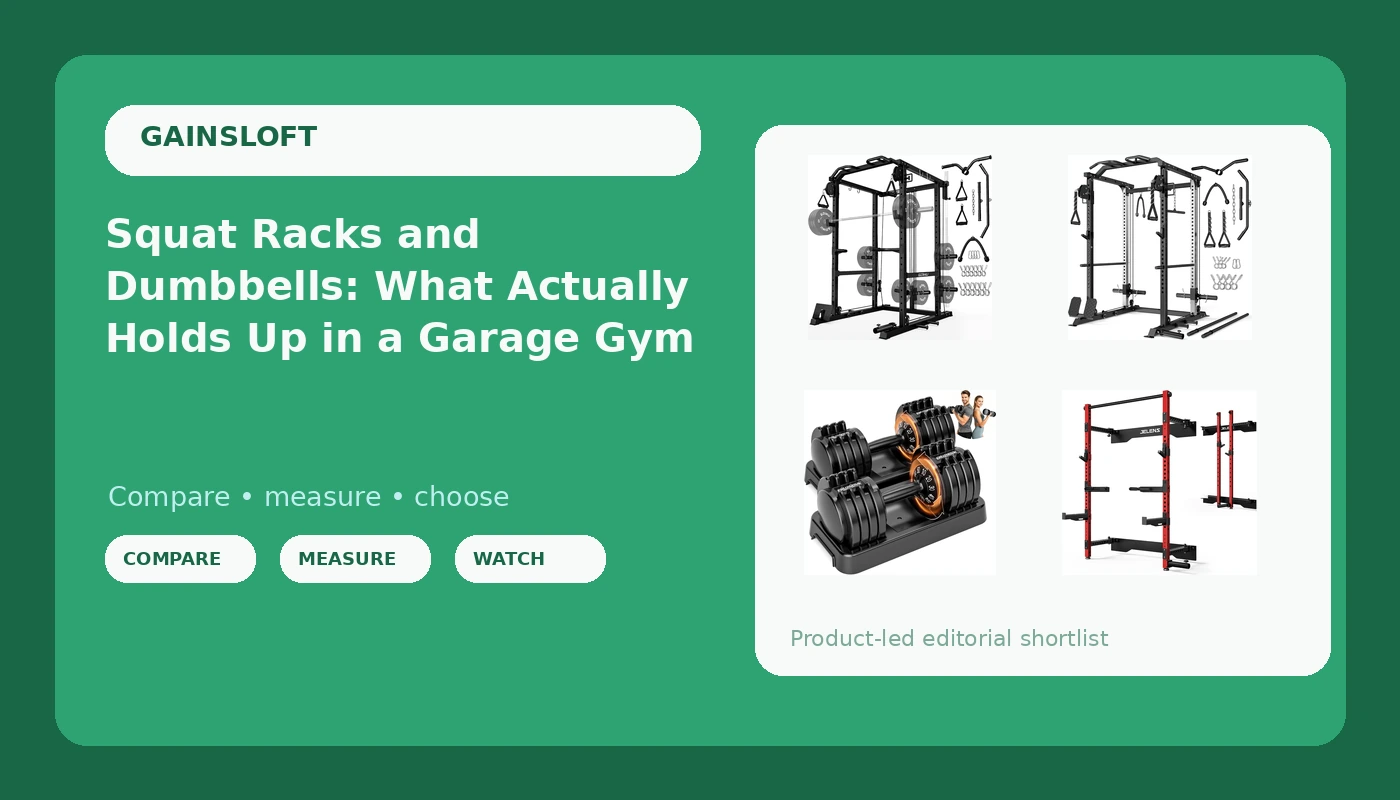
The rack is the decision that shapes everything else in a home gym. It sets your ceiling height requirement, your floor space, how you bench, where you press, and whether a missed rep lands on the safeties or on you. It is also the one piece of equipment that has to outlive every other piece you own. This is why a home gym power rack deserves more scrutiny than the bar, the plates, or the bench. Below are four current options, two full cages with cable systems, a folding wall mount, and an adjustable dumbbell set, along with the questions that separate a rack that holds from a rack that only looks like it will.
Related: How to Read a Squat Rack's Capacity Sticker →
Quick answer
A rack holds up because of its steel, its welds, and how it meets the floor, not because of the number printed on the sticker. Buy the thickest upright tubing your budget allows, confirm the safety bars and j-hooks are rated at or above the weight you actually train with, and decide up front whether you can anchor into a slab or a stud wall. If you want a full cage and cable work in a single footprint, the R1-V4 and the DP01 are the two full-cage options here. If floor space is the constraint, the JELENS FS01 folds back against a wall. If you want free weights without a rack footprint at all, the adjustable dumbbell set covers that lane.
Four useful options
| Model | Best fit | What stands out |
|---|---|---|
| R1-V4 Power Cage Rack, 2000LB Squat Rack with Cable Crossover System, Multi-Function Weight Cage, Home Gym Workout Machine with More Training Attachments | Full cage with integrated cable work | Cage, cable crossover, and a set of attachments in one frame |
| DP01 Power Cage, 2000LBS Squat Rack with Cable Crossover and Dual Independent Pulley System, Full Cage for Full Body Training, Power Rack with More Training Attachments for Home Gym | Full cage with independent pulleys | Dual independent pulley system built into a full cage |
| JELENS FS01 Folding Squat Rack, Wall Mounted Power Rack for Home Gym, Space Saving Multi-Functional Power Cage with More Attachments | Garages where floor space is tight | Folds against a wall and mounts to structure instead of standing on it |
| 25/50lbs Adjustable Dumbbell Set of 2, 5-in-1 Free Weights Set | Free weights with no rack footprint | One pair of dumbbells covering a 5-in-1 range of configurations |
Full cage with cable crossover: R1-V4 Power Cage Rack
The case for a full cage with a cable crossover is consolidation. You get the safety of a cage for squats and bench press, and you get pulley work without a second machine taking up the other half of the garage. The trade-off is footprint and height. A cage with a crossover occupies more floor than a folding rack, and the cable columns add to the upright height, so ceiling clearance matters before anything else. If your space allows it and you want one frame to cover barbell and accessory work, this is the shape to look at. Verify the attachment list and the safety rating before you commit.
Dual pulley full cage: DP01 Power Cage
Independent pulleys mean each side moves on its own, which matters for single-arm rows, unilateral presses, and any movement where the two arms should not be tied together by one cable. On a shared cable, one side always drags the other. On independent pulleys, the load path on each side is its own, and that is the difference between accessory work that feels like a machine and accessory work that feels like a compromise. The rest of the trade-off is the same as any full cage: floor space, ceiling height, and a safety system you check rather than assume.
Folding wall mount: JELENS FS01 Folding Squat Rack
A folding wall mount is the answer when the floor is the problem, not the budget. It folds back against the wall between sessions, which frees the bay for a car, a workbench, or anything else that shares the space. The catch is that everything depends on the wall. A wall mount only works if you hit structure, and if the studs are not where you need them, you are solving that problem before you can use the rack at all. Check stud spacing, the wall's construction, and the anchor specification before ordering, and confirm the folded depth still clears whatever else lives in that bay.
Adjustable dumbbell pair: 25/50lbs Adjustable Dumbbell Set of 2
Not every session needs a cage. Adjustable dumbbells handle the accessory half of a program, and this pair replaces a rack of fixed dumbbells with something you can slide under a shelf. The trade-off is the ceiling on load. An adjustable set has a top weight, and the range named in the listing is that ceiling, so check it against the weights you press and row before you buy. If your dumbbell work fits inside that range, this is the most space-efficient option on this page, and the one that does not care what your walls or your ceiling look like.
Prices and availability may change. Product images, names, and retailer links are matched to verified listings. No current price, rating, stock status, or measured result is stated here without current evidence.
What the capacity number on the sticker actually means
A capacity rating is a claim made by the seller, and it describes the whole assembly: uprights, crossmembers, j-hooks, safety bars, and hardware together. The part of that number that matters most is the safety system, because the safety bars and spotter arms are what catch a failed rep. A rack rated far above your working weight with safety bars rated well below it has its priorities backwards.
Steel thickness is the second thing to check, and it is the one the sticker never tells you. Serious racks are built from 11-gauge tubing, roughly 0.12 inches. Thinner tube flexes under load, and flex is what turns a stable rack into a rocking one. Welds are the third: a wide, pretty bead with shallow penetration is a cosmetic fix, not a joint, and the stress on a rack lands at the welds first. Hardware matters too. Bolts from a hardware store bin are not the same as graded fasteners, and a rack is only as rigid as the bolts holding it together.
Finally, treat a static capacity rating as exactly that. Setting a loaded bar down on the safeties is a controlled event. Dropping a missed rep into them is not, and the two do not load the frame the same way.
How the rack meets the floor decides how it behaves
There are three ways a rack can meet a garage floor, and each has a different failure mode.
A flat-foot rack sits on the floor without bolting. That is convenient for a rental, and it gives up stability to a bolted base at heavy loads. A bolt-down rack transfers load into the concrete, which is the strongest option available if you own the slab and are willing to put holes in it. A wall mount transfers load into the wall, which means the wall has to deserve that trust: studs at consistent spacing, anchors sized for the load, and a mounting height that matches your squat depth and your ceiling.
Height and footprint run alongside all of this. A full cage needs the upright height, your standing reach, and the bar itself to fit under the ceiling, and it needs the depth of the cage plus your walk-out space on the floor. A folding wall mount trades floor depth for wall length. A dumbbell set trades everything for a load ceiling.
- Measure ceiling height at the lowest point in the bay, not the average, and subtract the bar and your overhead reach.
- Confirm what is behind the wall or under the slab before you order anything that mounts or anchors.
- Match the safety system rating to the weight you actually miss at, not the weight you hope to lift.
- Read the tube gauge and the fastener grade, not the capacity sticker, and check the j-hooks for play.
- Budget the whole install: flooring, anchors, and only the attachments you will genuinely use.
Planning the footprint before the steel arrives
- Measure the ceiling at its lowest point, including any duct, light, or garage door rail that crosses the bay.
- Check the swing of every door within the rack's footprint, including the car door if the garage is shared.
- If you are mounting to a wall, confirm stud spacing and that you can hit structure where the uprights need to be.
- Plan flooring and anchoring together: rubber over concrete, with anchors sized for the slab rather than for the rack.
- Decide whether you need a cable system at all, or whether a barbell plus adjustable dumbbells covers your accessory work.
Which option should you choose?
Choose the R1-V4 Power Cage Rack when you want a full cage and a cable crossover in one frame and your ceiling and floor can carry the footprint. Choose the DP01 Power Cage when independent pulleys matter to your training and you want that cable station integrated into a full cage rather than standing beside it. Choose the JELENS FS01 Folding Squat Rack when floor space is the real constraint, you can anchor into structure, and the rack needs to disappear between sessions. Choose the 25/50lbs Adjustable Dumbbell Set of 2 when your dumbbell work fits inside the range named in the listing and you would rather not mount anything to anything.
The caveat is the same for all four. Capacity figures, attachment lists, and weight ranges come from the product listings, not from independent measurement here. Before you load any rack, verify the upright gauge, the hardware grade, the safety bar rating, and the anchor requirements with the manufacturer, and confirm your ceiling height and wall construction on site.
The bottom line
Two of these options are full cages and two are space solutions, and the right pick depends on the room you actually have rather than the weight you plan to lift. A full cage with a cable system gives you the most training in one frame, a folding wall mount gives you the most floor back, and an adjustable dumbbell pair gives you the least commitment of all. Whichever you choose, read the steel and the safety system before you read the sticker, and make sure whatever the rack attaches to is as serious as the rack itself.