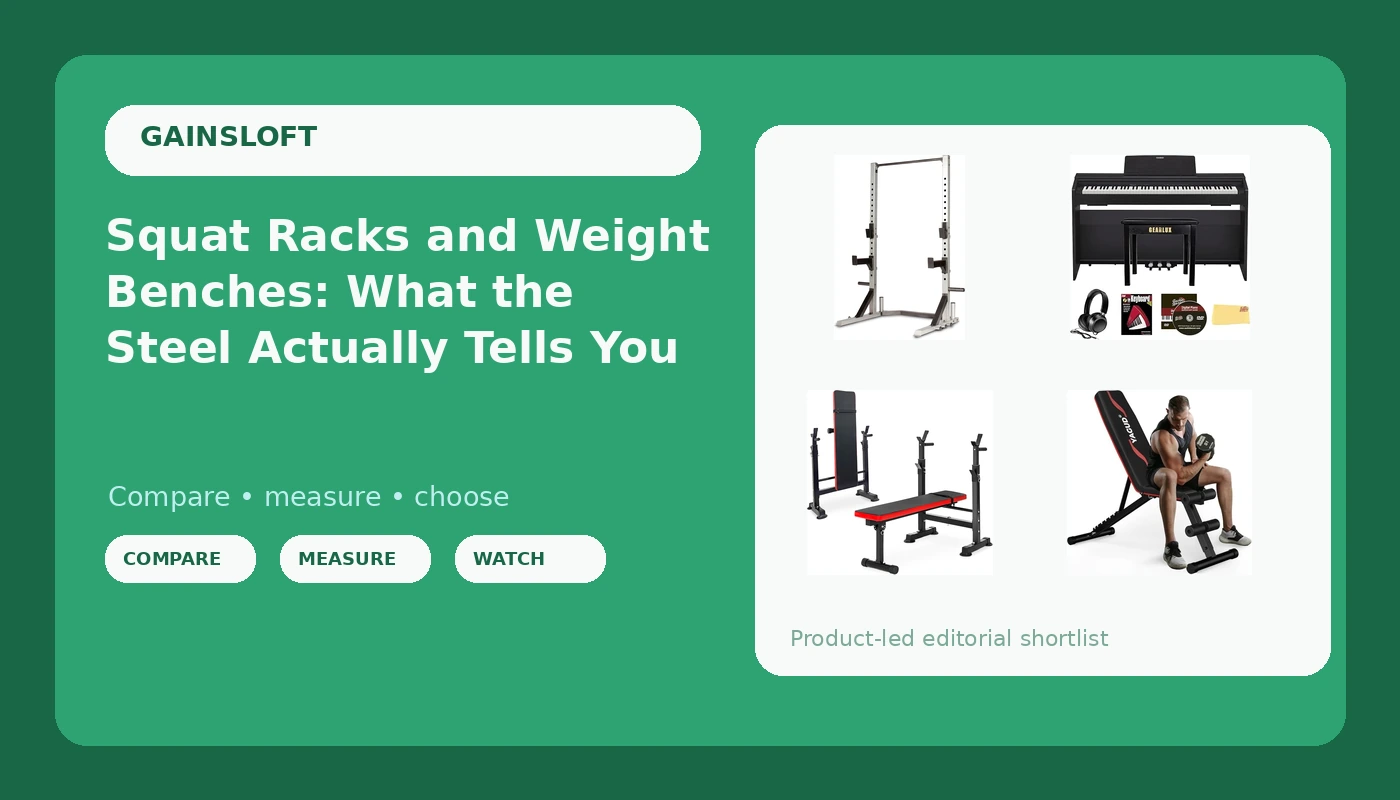
Most people shopping for home gym squat racks and benches stall in the same spot. Every listing uses the same words, the capacity stickers read like legal settlements, and none of it tells you whether the thing will still be standing when you miss a rep at your working weight. I spent four years as a welder's apprentice before I moved into industrial maintenance, and I read a rack the way I read a weld: where is the steel thickest, where does the load path run, and what happens at the exact moment everything goes wrong. What follows is a plain explanation of the four options in front of you, what each one is genuinely for, and where the honest limits sit.
Related: How to Anchor a Squat Rack Without Wrecking Your Garage Floor →
Quick answer
Buy the rack first and the bench second, and match both to the weight you actually handle rather than the weight printed on a sticker. The CAP Barbell Deluxe Power Rack Color Series is the dedicated upright structure in this group, the one you build the rest of a garage gym around. The BalanceFrom Adjustable Folding Multifunctional Workout Station is the compact all-in-one for a small space where pressing and squatting have to share one frame. The Yagud Weight Bench Press is the folding bench for a garage that also has to park a car. The Casio PX-870 Privia Digital Piano bundle is not gym equipment at all. It appeared in the same listing feed, and it is worth naming plainly so nobody orders a piano bench expecting to press on it.
Four useful options
| Model | Best fit | What stands out |
|---|---|---|
| CAP Barbell Deluxe Power Rack Color Series | A dedicated rack to grow into | Standalone four-upright power rack frame with a color-series finish |
| BalanceFrom Adjustable Folding Multifunctional Workout Station | Small spaces that need one frame for pressing and squatting | Adjustable, folding Olympic workout bench paired with a squat rack |
| Yagud Weight Bench Press | Garages that share floor space with a vehicle | Folding strength bench with adjustable positioning |
| Casio PX-870 Privia Digital Piano bundle | Not a gym purchase | A piano bundle with a furniture bench, headphones, and lesson materials |
The dedicated rack: CAP Barbell Deluxe Power Rack Color Series
Here is the trade-off nobody puts on the box. A power rack is a frame, and a frame is only as honest as the two things you cannot see in a product photo: the tube gauge and the weld penetration. A pretty bead that sits on top of the steel without fusing into it is a lie wearing a tuxedo. The same goes for hardware. Racks that ship with hardware store bolts instead of grade-8 fasteners are telling you what they think of your working weight.
What I can tell you from the listing is the shape of the thing: four uprights, a standalone structure, a color finish. What I cannot tell you from any listing is the gauge of the tube or how deep the welds bite. That is why the first thing I do with a new rack is put a caliper on the upright and a light on the weld toes. If the steel measures thinner than the sticker implies, the sticker is decoration.
The all-in-one: BalanceFrom Adjustable Folding Multifunctional Workout Station
The appeal here is arithmetic: one frame, one footprint, one purchase. The compromise is that a combination unit has more joints than a dedicated rack, and every joint is a place where movement can start. Folding mechanisms add pivot points. Adjustable back pads add pins and brackets. None of that is automatically bad, but it all has to be checked under load rather than admired in a photo.
If you go this route, the test that matters is the loaded one. Set the bench flat, load it, and watch the frame at the hinge. Then set it to incline, which is the position where benches actually fail, and watch it again. A station that stays quiet at your real working weight is doing its job. A station that shivers when you rack the bar is telling you its ceiling early, and you should believe it.
The folding bench: Yagud Weight Bench Press
A folding bench earns its place in a garage that does double duty. The question is whether the folding hardware is a convenience or a weak link. Side-to-side wobble on flat bench is the tell. If the pad rocks laterally before you even add weight, that movement multiplies once there is a bar in your hands and your feet are driving into the floor.
The bench is where people cheap out, and it is the second most dangerous piece of equipment in a home gym after the rack. That is not a reason to spend blindly. It is a reason to test the position you actually fail in. For most lifters that is incline, not flat, because incline changes the angle of the load path through the frame and the back pad.
The listing that is not gym equipment: Casio PX-870 Privia Digital Piano bundle
I am naming this one because it belongs in the conversation for exactly one reason: the word bench. A furniture bench that ships with a piano bundle and a weight bench that ships with a rack have almost nothing else in common. The piano bench is built to hold a seated player. The weight bench is built to hold a body plus a loaded bar, sometimes with the lifter's feet driving hard into the floor. If you searched for a bench and landed on a listing with a keyboard in the photo, that is the listing telling you what it is.
If you genuinely want a digital piano for the house, the bundle is a coherent package: piano, bench, headphones, and lesson materials. It just has no role in a lifting decision, and no place in a squat rack budget.
Prices and availability may change. Product images, names, and retailer links are matched to verified listings. No current price, rating, stock status, or measured result is stated here without current evidence.
Why the capacity sticker is not the spec that matters
A capacity rating is a claim, and a claim is only as good as the steel behind it. The number that actually governs how a rack behaves is the wall thickness of the upright, usually described in gauge. Serious racks are built from 11-gauge steel, roughly an eighth of an inch. Thinner tube flexes, and flex under a loaded bar is how racks start walking across a garage floor.
The second number is weld penetration, which is how deep the weld fuses into the base metal rather than sitting on the surface. You can often see it at the corners where the uprights meet the base: a weld that flows into the joint and shows a consistent toe line is doing work. A tall, narrow bead with undercut edges is cosmetic.
The third is hardware. Bolts that came from a bin at a hardware store are not the same as graded fasteners, and a rack that ships with soft bolts is a rack that expects you to be gentle with it. When you assemble anything, torque the fasteners in a cross pattern and re-check them after the first heavy session. Joints seat themselves under load, and a loose joint is a wobble waiting to happen.
Where benches actually fail
Benches rarely fail on flat bench with a light dumbbell. They fail at incline, under a real load, when the back pad is angled and the frame is transferring force through pins and brackets instead of straight down into the floor. That is why incline is the position worth testing, and why a bench that feels solid flat can still surprise you at 45 degrees.
Folding benches add a second failure point: the hinge. A hinge that locks positively with a thick pin and no perceptible play is doing its job. A hinge that clunks and shifts when you sit down is a hinge you will be thinking about mid-set, and thinking about your equipment mid-set is how form breaks down.
Then there is pad width and stability. A narrow, soft pad on a wide frame feels unstable even when the frame is fine, because your contact points are moving. Width is not a luxury. It is the difference between pressing and balancing.
- Measure the space first: ceiling height for overhead pressing, floor depth for a bar path, and door swing for anything that folds.
- Decide whether the rack can be anchored. A bolted base buys stability that a flat-foot design has to earn through mass and bracing.
- Compare the tube gauge against the capacity claim before you compare anything else, because the sticker is the marketing and the gauge is the fact.
- Choose the bench by the position you fail in, then load that position before you trust it.
- Open the hardware bag and check the fasteners before assembly day, because a missing grade-8 bolt is easier to solve on a Tuesday than on a Saturday.
Practical guidance before you order
- Set a floor budget for the rack and the bench together, then decide which one gets the upgrade. The rack outlives everything else you own.
- Read the return policy on anything that folds. Folding hardware is the part most likely to send you back to the listing.
- Plan the anchor points before the rack arrives. Concrete anchors and stud layout are decisions you want to make with a tape measure, not an impact driver.
- Keep the safety bars or spotter arms at a height that catches a failed rep rather than a completed one, and set them before your first heavy set, not after.
- Check the listing photos for what the item actually is. A keyboard in the picture means a piano bench, and a piano bench is not rated for pressing.
Which option should you choose?
Choose the CAP Barbell Deluxe Power Rack Color Series when you want a dedicated upright frame and a rack to grow into. Choose the BalanceFrom Adjustable Folding Multifunctional Workout Station when floor space is tight and one adjustable frame has to cover both pressing and squatting. Choose the Yagud Weight Bench Press when you need a bench that folds and stows between sessions. Choose the Casio PX-870 Privia Digital Piano bundle only when what you actually want is a piano.
The honest caveat is that listings tell you shape, not substance. Gauge, weld quality, bolt grade, and how a frame behaves at its rated load are not visible in a product photo, and no article can measure them for you. Treat every capacity sticker as a claim to verify against the steel in front of you, and test the bench in the position you actually fail in before you load it heavy.
The bottom line
The rack is the piece that has to outlive every other piece in your gym, so it gets the budget and the scrutiny. The bench comes second, and it gets tested at incline because that is where it earns or loses your trust. A compact all-in-one is a legitimate answer for a small garage, a folding bench is a legitimate answer for a shared one, and a piano bundle is a piano bundle. Buy the steel that holds at your working weight, bolt what needs bolting, and check the hardware in the box before you trust it with your neck.